What Are Bio-Fermented Actives, and Are They the Future of Synthetic and Animal-Derived Ingredients?
What Are Bio-Fermented Actives? | Fermented Hyaluronic Acid — How Is It Made? |Fermented Squalane vs Shark-Derived Squalane — What Is the Difference? |Why Are Bio-Fermented Actives Replacing Some Synthetic and Animal-Derived Ingredients? | How Can a Skincare Brand Start Using Fermented Actives? | What Are the Main Formulation Challenges With Fermented Actives?| What Is the Difference Between Fermented, Synthetic and Animal-Derived Ingredients?|The skincare industry is moving beyond the simple question of whether an ingredient is natural or synthetic. Brands are now looking more closely at how an ingredient is produced, where it comes from, how consistently it can be supplied, and what environmental or ethical considerations are associated with its production.
This is where bio-fermentation is becoming increasingly relevant.
Bio-fermented skincare ingredients are produced using microorganisms or biological fermentation processes to create or transform cosmetic ingredients under controlled conditions. Depending on the ingredient, fermentation can provide a practical alternative to certain animal-derived raw materials or help produce highly consistent ingredients without relying on traditional extraction routes.
Fermented hyaluronic acid is one of the clearest examples. Modern cosmetic hyaluronic acid is commonly produced through microbial fermentation rather than being extracted from animal tissues. Squalane provides another important example: biotechnology can be used to produce plant-origin squalane from renewable feedstocks, offering an alternative to shark-liver-derived squalane.
Probiotic and postbiotic ingredients are also expanding the conversation, although cosmetic formulations require careful distinction between live microorganisms, lysates, ferments, and postbiotic materials.
For skincare entrepreneurs, the opportunity is not simply to put the word “fermented” on a label. The real opportunity is to build products around traceable, biotechnology-derived ingredients with defined specifications, appropriate testing, and credible sustainability or vegan positioning.
What Are Bio-Fermented Actives?
Bio-fermented actives are cosmetic ingredients produced, modified, or obtained through controlled biological fermentation processes. In cosmetic manufacturing, microorganisms such as bacteria or yeast can be used as biological production systems for selected ingredients.
Fermentation can help manufacture ingredients that would otherwise require animal-derived raw materials, intensive chemical processing, or less consistent biological extraction.
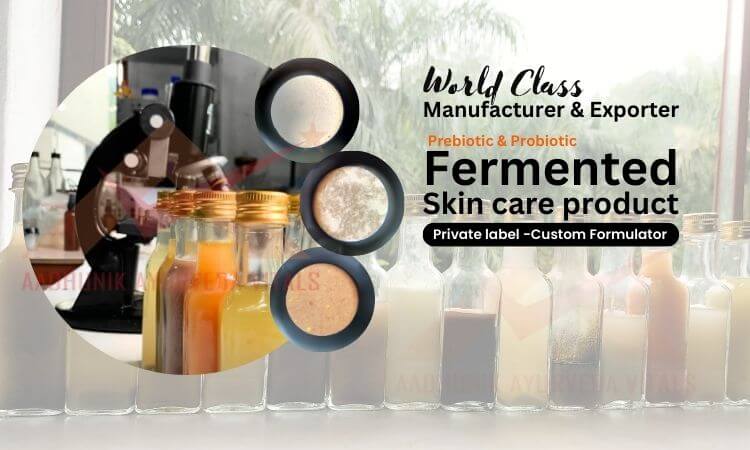
The process generally involves a controlled production environment in which a microorganism is supplied with nutrients and other conditions required for growth or production. After fermentation, the desired material is separated, purified and processed to meet the required cosmetic specification.
The final cosmetic ingredient is not necessarily a “live ferment.” It may be a purified molecule, a fermented botanical material, a microbial lysate, or another defined ingredient derived from the process.
This distinction matters for product development.
Fermented Hyaluronic Acid — How Is It Made?
Fermented hyaluronic acid is generally produced through microbial fermentation.
Historically, hyaluronic acid was associated with animal-derived sources, but modern cosmetic production commonly uses biotechnology-based fermentation routes. Microorganisms are used to produce hyaluronic acid, which is subsequently recovered and purified.
For a skincare brand, the important point is that the final ingredient needs to be evaluated according to its actual specification rather than its marketing story.
Brands should ask suppliers about:
- Molecular weight or molecular-weight distribution
- Purity
- Concentration
- Microbial specifications
- Residual processing materials
- Recommended use level
- pH compatibility
- Storage requirements
- Supporting documentation
Different molecular weights can also produce different formulation characteristics and sensory behaviour.
Fermented Squalane vs Shark-Derived Squalane — What Is the Difference?
Squalane is a lightweight emollient used in facial oils, moisturisers, serums, haircare and other cosmetic products.
Historically, squalane was associated with shark liver oil. Today, plant-derived and biotechnology-derived sources are widely available and have become important alternatives.
Fermentation-based production can use renewable feedstocks to produce a highly purified squalane ingredient without sourcing it from shark liver.
This makes fermented squalane particularly interesting for brands developing vegan or animal-free product lines.
However, brands should not assume that every squalane on the market is fermented. Squalane can come from different production pathways, so the supplier's technical documentation and certification should be checked.
How Do Probiotics and Postbiotics Work in Skincare?
The term “probiotic skincare” can be confusing because cosmetic products do not all contain live probiotic microorganisms.
Cosmetic formulations may instead contain:
- Fermented ingredients
- Microbial lysates
- Ferment filtrates
- Postbiotic materials
- Metabolites produced during fermentation
A postbiotic approach generally focuses on preparations derived from microorganisms that contain non-living microbial components or their products.
This can be easier to formulate than a product containing live microorganisms because conventional cosmetic preservation, temperature control and shelf-life requirements can be difficult to reconcile with living microbial cultures.
For brands, the exact ingredient identity should therefore be understood before making claims such as “probiotic,” “fermented,” or “microbiome-friendly.”
Why Are Bio-Fermented Actives Replacing Some Synthetic and Animal-Derived Ingredients?
Bio-fermentation is not replacing every synthetic cosmetic ingredient, nor is fermentation automatically superior. Its real value is that it gives manufacturers another production pathway for selected ingredients.

The strongest opportunities appear where biotechnology can combine consistent quality, scalable production, animal-free sourcing and a strong technical profile.
| Ingredient Category | Traditional/Alternative Source | Bio-Fermentation Opportunity | Brand Positioning |
|---|---|---|---|
| Hyaluronic acid | Animal or biotechnology routes | Microbial fermentation | Biotechnology-derived hydration |
| Squalane | Shark liver oil or plant-derived routes | Fermentation-based production | Vegan/animal-free emollient |
| Fermented botanicals | Conventional extracts | Controlled fermentation | Fermented botanical skincare |
| Microbial ingredients | Conventional biological materials | Ferment/lysate/postbiotic production | Microbiome-focused positioning |
| Selected specialty actives | Chemical or biological production | Microbial biotechnology | Biotechnology-led formulation |
The advantage depends on the ingredient.
Are Fermented Ingredients More Sustainable?
Potentially, but sustainability should never be assumed from the word “fermented” alone.
A fermentation process may reduce dependence on animal-derived raw materials and can offer controlled production with consistent output. Some biotechnology routes can also use renewable feedstocks.
But a genuine sustainability assessment should consider:
- Raw-material origin
- Feedstock source
- Fermentation energy requirements
- Water use
- Downstream purification
- Waste management
- Transportation
- Packaging
- Manufacturing efficiency
A brand should therefore avoid broad claims such as “zero impact” or “completely sustainable” unless it has evidence to support them.
Are Bio-Fermented Ingredients Better for Skin?
Not automatically.
A cosmetic ingredient performs according to its chemistry, purity, concentration, formulation environment and compatibility with the finished product.
Fermentation may provide an efficient way to manufacture an ingredient, but the fermentation process itself does not guarantee better skin performance.
For manufacturers, the correct approach is to evaluate the ingredient based on its technical specification and available evidence.
This is particularly important when comparing two ingredients that have the same or similar chemical identity but different production methods.
How Can a Skincare Brand Start Using Fermented Actives?
A brand does not need to build a fermentation facility to launch a fermented skincare product.
For most startups, the practical route is to source a finished cosmetic-grade ingredient from a qualified supplier and work with a formulation team or manufacturer that understands its technical requirements.
The process can be divided into several steps.
Step 1 Define the Product Concept
Start with the finished product rather than the ingredient.
For example:
- Hydrating serum with fermented hyaluronic acid
- Lightweight moisturiser with biotechnology-derived squalane
- Fermented botanical essence
- Postbiotic facial serum
- Fermented scalp treatment
- Barrier-supporting cream
The product concept determines which ingredients make technical and commercial sense.
Step 2 Find Qualified Suppliers
When sourcing sustainable cosmetic ingredients suppliers, do not evaluate suppliers only by price.
Request technical documents such as:
- Product specification
- Certificate of Analysis
- INCI information
- Recommended usage level
- Technical data sheet
- Safety documentation where applicable
- Allergen information where relevant
- Country of origin
- Production method information
- Certification documents, if claimed
For brands interested in clean beauty ingredient sourcing India, local availability can reduce lead times and simplify communication, but international ingredient suppliers may provide a wider selection of specialised biotechnology materials.
Step 3 Check the Ingredient's Actual Identity
This step is frequently overlooked.
A supplier may describe an ingredient as fermented, biotechnology-derived, natural-origin or vegan. These terms should be checked against technical documentation and certification.
For example, a brand should distinguish between:
“Produced through fermentation”
and
“Contains a fermented botanical extract.”
They are not necessarily the same thing.
Step 4 Test the Ingredient in the Formula
An ingredient that looks impressive on paper may not work well in the finished formulation.
The manufacturer should assess:
- pH compatibility
- Solubility or dispersion
- Temperature sensitivity
- Interaction with other ingredients
- Preservation system
- Texture
- Colour
- Odour
- Stability
- Packaging compatibility
Step 5 Scale After Validation
The laboratory sample should not automatically become the commercial formula.
The formulation should be checked again at larger batch sizes because mixing, heating, cooling and processing conditions can change when moving from laboratory equipment to manufacturing equipment.
This is especially important for startups planning private label fermented skincare, because the commercial product must perform consistently across batches.
What Are the Main Formulation Challenges With Fermented Actives?
Fermented ingredients can provide exciting formulation opportunities, but they also introduce technical questions that need to be addressed before commercial production.
One of the biggest mistakes is assuming that a fermented ingredient can simply be added to any existing formula.
pH Compatibility
Some fermented materials are sensitive to formulation pH.
The final pH should be selected based on the complete formula, including the active ingredients, preservative system and intended application.

Preservation
A fermentation-derived ingredient may contain residual nutrients or biological components that affect formulation behaviour.
This does not mean every fermented ingredient is difficult to preserve. It means the finished product should be evaluated as a complete system.
The preservation strategy should be validated through appropriate testing rather than assumed from the ingredient's marketing description..
Stability
Some actives may be sensitive to:
- Heat
- Light
- Oxygen
- Water activity
- Extreme pH
- Long storage periods
Manufacturers should therefore follow the supplier's recommended processing conditions.
Adding a heat-sensitive active early in a high-temperature manufacturing process may reduce its performance.
Raw-Material Consistency
Fermented materials can vary depending on the fermentation organism, feedstock, process conditions, purification and downstream processing.
For commercial manufacturing, the specification needs to be clear enough to maintain batch-to-batch consistency.
This is why a good supplier should provide defined specifications rather than relying only on a marketing description.
What Is the Difference Between Fermented, Synthetic and Animal-Derived Ingredients?
The terms “fermented,” “synthetic,” and “animal-derived” describe different aspects of ingredient production and sourcing.
They should not be treated as three simple quality categories.
| Factor | Bio-Fermented | Synthetic | Animal-Derived |
|---|---|---|---|
| Production route | Biological fermentation | Chemical or synthetic process | Animal-derived raw material |
| Animal-free potential | Often yes, depending on source | Usually yes | No |
| Vegan potential | Often yes, if verified | Usually yes, if verified | No |
| Consistency | Can be highly controlled | Often highly controlled | Can depend on biological source |
| Sustainability | Depends on complete process | Depends on process | Depends on source and harvesting |
| Consumer positioning | Biotechnology, fermented, animal-free | Science-led, functional | Traditional animal-derived source |
| Certification need | Recommended for claims | Recommended for claims | Source documentation important |
The table also shows why a brand should not use “natural versus synthetic” as its only decision-making framework.
A biotechnology-derived ingredient can have a highly controlled manufacturing process and a defined chemical identity. At the same time, a naturally sourced ingredient can vary significantly depending on its source and processing.
For product developers, function, safety, consistency, sourcing and evidence should come before marketing terminology.
Is Fermented Squalane Better Than Shark-Derived Squalane?
For brands seeking animal-free or vegan formulations, plant-derived and biotechnology-derived squalane can offer a practical alternative to shark-derived sources.
Squalane itself is an emollient. The source does not automatically change the fundamental purpose of the ingredient in a formula.
The commercial difference is largely about sourcing, production route and brand positioning.
A brand developing a vegan skincare line may therefore prefer a verified plant-origin or biotechnology-derived squalane.
However, the term “vegan” should be supported by the appropriate supplier documentation or certification where the brand chooses to make a certified claim.
Manufacturers should also check:
- Purity
- Oxidative stability
- Odour
- Sensory profile
- Recommended use level
- Compatibility with the formula
- Supplier consistenc
This allows the brand to make the sourcing decision based on technical and commercial requirements rather than marketing language alone.
What Certifications and Documentation Should Brands Check?
Certifications are useful, but the appropriate certification depends on the claim being made.
A brand should first identify the claim it wants to make and then determine what evidence is needed to support it.
Relevant standards or certification systems may include:
- COSMOS
- ECOCERT certification under applicable programmes
- Leaping Bunny or other recognised cruelty-free programmes
- ISO 16128 for natural-origin calculations and terminology
- Relevant quality-management or manufacturing standards
- Supplier-specific vegan certification where applicable
ISO 16128 should be understood correctly: it provides guidelines for definitions and calculations relating to natural and organic cosmetic ingredients and products; it is not itself a certification that makes a product “organic.”
What Should a Supplier Provide?
A professional ingredient supplier should be able to provide appropriate documentation for the material being supplied.
Depending on the ingredient, this can include:
- COA
- Specification sheet
- INCI name
- Technical data sheet
- Safety documentation
- Origin information
- Recommended storage conditions
- Microbiological specifications
- Certification documents
- Batch information
For a finished cosmetic product, the manufacturer and brand also need to consider the requirements of the target market.
What Are the Regulatory and Labelling Considerations?
Bio-fermented ingredients do not create a separate universal regulatory category simply because they are fermented.
The finished cosmetic product must comply with the regulations applicable to the market where it is placed on the market.
For an India-focused brand, the manufacturer should evaluate applicable requirements under the Indian cosmetics regulatory framework and relevant Indian standards.
For the United States, cosmetic products are subject to applicable requirements administered by the FDA, including the modern requirements introduced under MoCRA.
For the European market, cosmetic products fall under the EU Cosmetics Regulation and related requirements.
The ingredient also needs to be correctly identified using its applicable INCI name.
This is particularly important for marketing terms such as:
- Fermented
- Bio-fermented
- Vegan
- Animal-free
- Probiotic
- Postbiotic
- Natural-origin
- Sustainable
A claim should reflect the actual ingredient and supporting evidence.
For example, if a product contains a microbial lysate rather than live microorganisms, calling it a “live probiotic skincare product” could create a misleading impression.
Regulatory review should therefore happen before packaging artwork is finalised.
Which Skincare and Haircare Products Can Use Bio-Fermented Actives?
Bio-fermented ingredients can be incorporated into a wide range of product formats.
Facial Skincare
Potential product categories include:
- Hydrating serums
- Barrier-supporting moisturisers
- Facial creams
- Lightweight emulsions
- Facial oils
- Essence products
- Eye-area products
- Overnight treatments
- Cleansing products
Fermented hyaluronic acid can be particularly relevant to hydration-focused formulations, while biotechnology-derived squalane can work well in emollient-rich products.
Haircare
The opportunity also extends to haircare.
Potential products include:
- Hair serums
- Scalp serums
- Leave-in conditioners
- Hair masks
- Conditioning creams
- Hair oils
- Scalp moisturisers
A brand does not need to use multiple fermented activities in every product. A focused product range with one or two well-selected biotechnology-derived ingredients can often create a clearer product story.
Fermented Botanical Products
Fermentation can also be used with botanical materials
Potential formats include:
- Fermented botanical toners
- Essence products
- Facial serums
- Scalp treatments
- Botanical masks
- Cleansing products
However, the manufacturer should evaluate the fermented botanical material based on its actual specification, not simply its plant origin.
How Much Does It Cost to Develop Bio-Fermented Skincare?
There is no fixed cost for developing a fermented skincare product because the total investment depends on the active ingredient, formulation complexity, MOQ, packaging, testing and manufacturing process.
For a startup, it is more useful to divide the budget into separate categories.
| Cost Area | What Influences the Cost |
|---|---|
| Ingredient | Type, purity, concentration and supplier |
| Formulation | Simple base versus advanced custom formulation |
| Samples | Number of prototypes and modifications |
| Testing | Stability, microbial and other relevant testing |
| Packaging | Bottle, tube, jar, pump and material |
| Manufacturing | Batch size and processing requirements |
| Compliance | Market-specific requirements and documentation |
| Branding | Labels, cartons and artwork |
| Logistics | Ingredient and finished-product transportation |
The active ingredient itself may increase the formula cost, but this does not necessarily make the finished product commercially unviable.
For example, a low-use-level active can have a relatively small effect on the cost per unit even if its price per kilogram is high.
The correct calculation is therefore based on cost-in-use, not simply price per kilogram.
A useful calculation is:
Ingredient cost per unit = ingredient price per kilogram × ingredient percentage used ÷ 1000 × product fill weight
This gives a much more realistic understanding of how an expensive activity affects the final product.
Can Small Skincare Startups Use Bio-Fermented Ingredients?
Yes. A startup does not need a large production facility or its own fermentation laboratory to create products using biotechnology-derived cosmetic ingredients.
The practical model is to purchase qualified finished ingredients and work with a manufacturer that has formulation and testing capabilities.
For a small brand, starting with one hero product can be more manageable than launching an entire fermented skincare collection.
For example:
Product concept → ingredient sourcing → laboratory sample → testing → packaging selection → pilot batch → commercial production
A startup can also use a low-MOQ manufacturing model where available, allowing it to test consumer demand before committing to large inventory volumes.
The key is to select a manufacturer that understands the technical requirements of the active rather than treating it as a simple catalogue ingredient.
Should Brands Manufacture Fermented Ingredients In-House or Buy Them?
For most new skincare brands, purchasing finished cosmetic-grade fermented ingredients is considerably more practical than building an in-house fermentation operation.
In-house fermentation requires specialised:
- Equipment
- Microbial controls
- Production facilities
- Process development
- Purification systems
- Quality-control procedures
- Technical expertise
- Regulatory and safety systems
A finished ingredient supplier has already developed the production process and can provide a defined material for cosmetic formulation.
In-house fermentation becomes more relevant for larger companies that want to develop proprietary biotechnology platforms or unique fermentation processes.
For a startup, the better investment is usually in product formulation, testing, brand development and market validation rather than building an ingredient-production facility.
How Can Brands Market Bio-Fermented Ingredients Without Greenwashing?
The word “fermented” can sound innovative, but it should not become a substitute for evidence.
A credible brand should explain what was actually fermented, what the resulting ingredient is, and why the ingredient was selected.
Instead of making vague claims such as:
“Next-generation sustainable biotechnology that completely transforms your skin.”
A more transparent approach is:
“Formulated with biotechnology-derived squalane selected as an animal-free emollient.”
The second statement gives the consumer something concrete to understand.
Brands should also avoid assuming that:
fermented = natural = sustainable = better
These are separate concepts.
A fermented ingredient may be biotechnology-derived but not certified organic. A natural-origin ingredient may not be sustainably sourced. A vegan ingredient may still have a significant environmental footprint.
Good product communication connects the marketing claim with actual supplier documentation, certification and formulation evidence.
What Is the Future of Bio-Fermented Skincare Ingredients?
The future of fermentation in cosmetics is likely to move toward more specialised ingredients rather than simply more products carrying the word “fermented.”
Biotechnology can help manufacturers explore new production routes for:
- Functional emollients
- Hydration ingredients
- Antioxidant compounds
- Fermented botanicals
- Postbiotic materials
- Specialty cosmetic actives
- Novel biomaterials
The strongest opportunity is the combination of biotechnology with modern formulation science.
Instead of asking whether an ingredient is natural or synthetic, manufacturers can increasingly ask
Can we produce this ingredient more consistently, without animal sourcing, with a better-controlled supply chain and with evidence supporting its intended cosmetic function?
That is a much more useful question for product development
For beauty entrepreneurs, this shift creates opportunities for products that combine clean-label positioning with credible science.
Final Takeaway, Why Bio-Fermentation Is Becoming Important for Beauty Brandsy
Bio-fermentation is changing how some cosmetic ingredients can be produced.
Its importance is not simply that it sounds more natural or innovative. The real value lies in the ability to use controlled biological processes to produce selected ingredients with defined specifications and, in some cases, provide alternatives to animal-derived sourcing.
Fermented hyaluronic acid demonstrates how biotechnology can become part of mainstream cosmetic ingredient production. Biotechnology-derived squalane shows how fermentation can support the move away from shark-derived sourcing. Ferments, lysates and postbiotic ingredients are also opening new possibilities for skincare formulation.
For beauty brands, the opportunity is to use these ingredients thoughtfully.
The most successful products will not rely on the word “fermented” alone. They will combine:
Verified sourcing + appropriate formulation + stability testing + credible claims + transparent documentation + strong product positioning
For manufacturers, this means understanding the ingredient before adding it to a formula, checking supplier documentation, evaluating compatibility, and testing the finished product under appropriate conditions.
For startups, it means that biotechnology does not have to remain limited to large cosmetic companies. Finished cosmetic-grade ingredients can allow smaller brands to develop modern formulations without building their own fermentation facilities.
The future of clean beauty is therefore unlikely to be a simple battle between “natural” and “synthetic.”
It is more likely to be about better production methods, responsible sourcing, ingredient traceability, formulation performance and evidence-based product development.
Bio-fermented activities are an important part of that transition, and they give skincare and haircare brands a practical opportunity to build products around the next generation of cosmetic biotechnology.
FAQs:
1. What is fermented hyaluronic acid and how is it different from normal hyaluronic acid?
Fermented hyaluronic acid is commonly produced through microbial fermentation rather than animal-derived extraction. The important difference is primarily the production route and source. The finished hyaluronic acid must still be evaluated according to its molecular characteristics, purity, concentration, formulation compatibility and quality specifications.
2. Is fermented squalane vegan?
It can be. Biotechnology-derived squalane can be produced without shark-derived raw materials and may qualify for vegan positioning when its complete supply chain meets the relevant requirements. Brands should verify the supplier's source and supporting documentation before making a vegan claim.
3. What is the difference between probiotics and postbiotics in skincare?
Probiotics generally refer to live microorganisms, while postbiotic ingredients are non-living preparations or components derived from microorganisms and their fermentation processes. Many cosmetic products use lysates, ferments or postbiotic materials rather than live microorganisms because maintaining live cultures in a preserved cosmetic formula can be technically challenging.
4. Are fermented cosmetic ingredients expensive?
Some are more expensive than conventional commodity ingredients, but the effect on the finished product depends on the ingredient's usage level. A high-priced ingredient used at a low concentration may add only a modest amount to the cost per finished unit.
5. Do fermented actives have a longer shelf life?
Not necessarily. Shelf life depends on the specific ingredient, formulation, packaging, preservation system and storage conditions. A fermented ingredient should not automatically be assumed to have a longer shelf life simply because it was produced through fermentation.
6. Where can small skincare businesses source fermented ingredients?
Small brands can source cosmetic-grade fermented ingredients through specialised ingredient suppliers and distributors in India or international markets. The supplier should be evaluated for documentation, technical support, consistency, minimum order quantities and ability to provide the required specifications.
7. Are fermented ingredients suitable for sensitive skin?
They can be, but “fermented” does not automatically mean that an ingredient is suitable for sensitive skin. The finished formula, concentration, supporting ingredients, fragrance system, pH and overall product design all influence suitability.
8. What certifications are important for fermented skincare ingredients in India?
There is no single certification required simply because an ingredient is fermented. The relevant documentation depends on the ingredient, the claim and the finished product. Brands should review applicable cosmetic requirements and verify claims such as vegan, natural-origin, organic or cruelty-free through appropriate documentation or certification.
9. What is the MOQ for fermented cosmetic ingredients?
MOQ varies considerably between suppliers and ingredients. Commodity fermentation-derived ingredients may be available in smaller quantities through distributors, while specialised activities may require larger commercial orders. Startups should ask for both sample quantities and commercial MOQ before finalising the formula.
10. Can fermented ingredients be used in private label skincare?
Yes. A manufacturer can formulate private label products using suitable commercially available fermented ingredients, provided the ingredients are compatible with the formula and the required testing and documentation are completed. Custom formulation gives a brand more control over the ingredient system and product positioning.
11. Are bio-fermented ingredients better than synthetic ingredients?
Not universally. Bio-fermentation is a production technology, not a guarantee of superior cosmetic performance. Its advantages may include animal-free sourcing, controlled production and specific sustainability opportunities. The ingredient should still be evaluated based on safety, performance, consistency, cost and evidence.