Why Some Ayurvedic Products Don’t Work (Manufacturer Insights)
The Biggest Misconception: Ayurveda Should Work Instantly | Poor Ingredient Quality: The Root Cause of Failure |Fresh Herbs vs Processed Extracts: What Actually Performs Better? |Wrong Extraction Methods Destroy Product Performance | Low Active Concentration: The Hidden Market Problem | Cheap Manufacturing Often Means Weak Formulations |The Ayurvedic industry has experienced massive growth over the last decade. Consumers across the world are turning toward herbal skincare, Ayurvedic wellness, and plant-based formulations with the expectation that natural products are safer, gentler, and more effective. However, one common concern continues to surface among customers and even brand owners: “Why do some Ayurvedic products not work?”
This question is important because Ayurveda is often positioned as a holistic system of wellness with centuries of trust behind it. Yet, many consumers try a herbal shampoo, skincare cream, oil, or supplement and claim they saw “no results.” From a manufacturer’s perspective, the reality is much deeper than simply saying a product works or does not work.
At Aadhunik Ayurveda, we believe that the effectiveness of Ayurveda depends on several factors, ingredient quality, formulation science, extraction methods, consistency, user expectations, and manufacturing standards. In many cases, products fail not because Ayurveda does not work, but because the formulation itself lacks authenticity, potency, or scientific balance.
For brands entering the herbal industry, partnering with an experienced Ayurvedic manufacturer in India is one of the biggest factors influencing Ayurvedic product effectiveness, long-term customer satisfaction, and repeat purchases.
Understanding Ayurvedic products not working requires looking beyond marketing and deeply understanding how Ayurvedic products are actually developed.
A professional Ayurvedic skincare manufacturer India focuses on scientific formulation, ingredient quality, and standardized production to ensure consistent product performance rather than relying solely on marketing claims.
The Biggest Misconception: Ayurveda Should Work Instantly
One of the biggest reasons consumers believe Ayurvedic products do not work is unrealistic expectations. Modern consumers have become accustomed to quick fixes. Chemical-based skincare often gives temporary visible results quickly because of silicones, strong actives, artificial fragrances, and instant sensory effects.
Ayurveda works differently.
From a manufacturer’s perspective, Ayurvedic product effectiveness depends on restoring balance rather than masking symptoms. Ayurvedic formulations often focus on strengthening the skin barrier, nourishing hair roots, improving scalp condition, or gradually improving skin texture.
This means:
- Results may take longer but are more sustainable
- Products work with the body's natural processes
- Enhancing usability without compromising product integrity
For example, an Ayurvedic hair oil may reduce hair fall gradually by strengthening follicles rather than creating instant cosmetic smoothness.
At Aadhunik Ayurveda, we educate brands and consumers that herbal efficacy should be evaluated realistically and not compared unfairly with quick-result synthetic formulations.
Poor Ingredient Quality: The Root Cause of Failure
The effectiveness of any Ayurvedic product starts with raw materials. Unfortunately, many products in the market use low-grade herbs, adulterated extracts, or poorly sourced ingredients to reduce costs.
From a manufacturer’s perspective, one of the biggest reasons behind why Ayurvedic products fail is compromised ingredient sourcing.
A herb harvested incorrectly or stored poorly loses potency. For instance:
- Old herbs may lose active compounds
- Improper drying may destroy nutrients
- Cheap sourcing may introduce adulteration
At Aadhunik Ayurveda, ingredient sourcing is one of the most important stages of production because product quality can never exceed raw material quality.
The quality of herbs selected by a trusted herbal product manufacturer India directly influences the potency, safety, and effectiveness of every Ayurvedic formulation.
Common Raw Material Problems
| Problem | Impact on Product |
|---|---|
| Adulterated herbs | Reduced efficacy |
| Poor harvesting | Loss of active compounds |
| Improper storage | Degradation of potency |
| Low-grade suppliers | Inconsistent performance |
This is why choosing a reliable Ayurvedic skincare manufacturer India becomes essential for brands that genuinely want effective products.
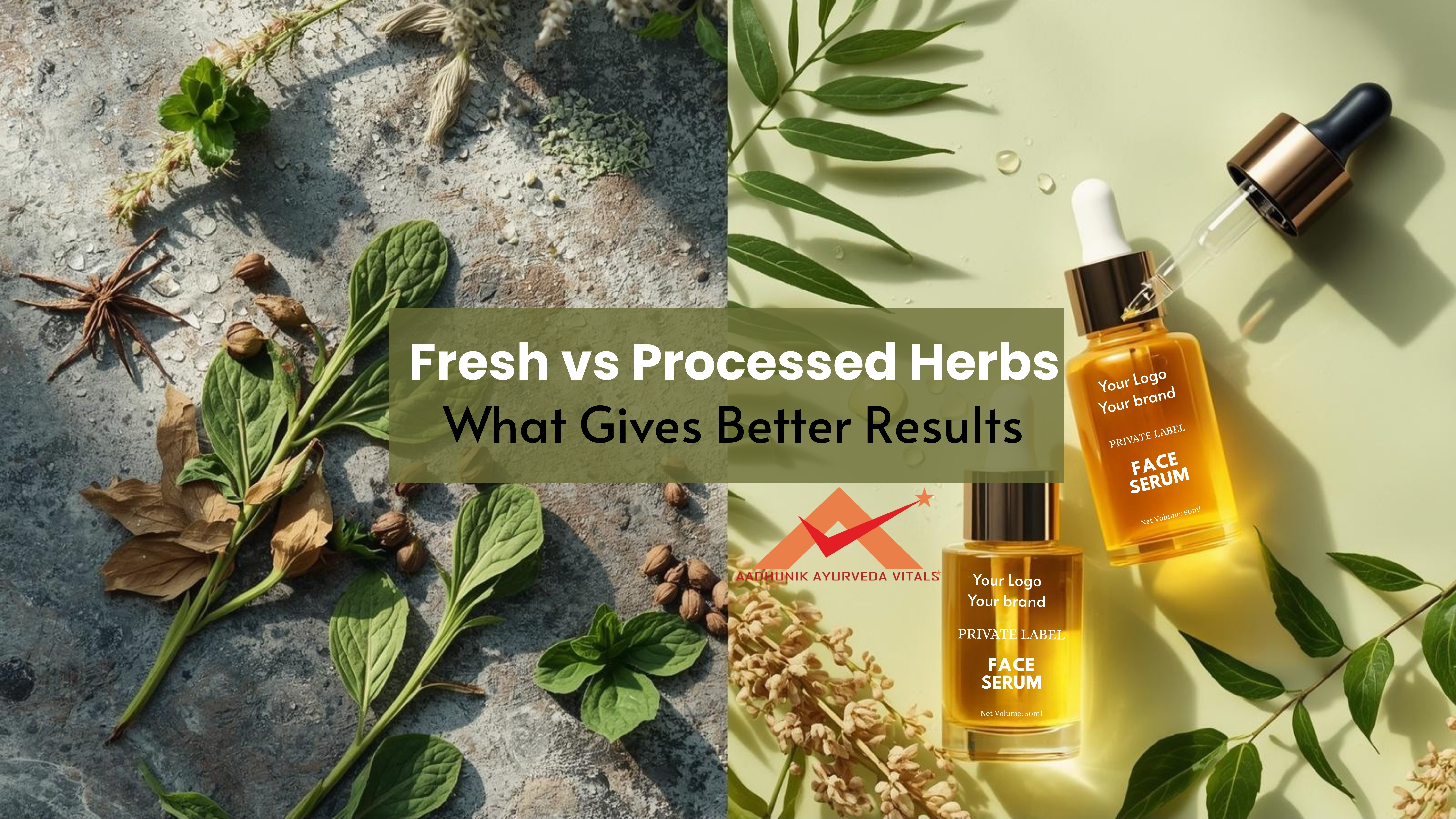
Fresh Herbs vs Processed Extracts: What Actually Performs Better?
One major challenge in Ayurvedic manufacturing is deciding between fresh herbs and highly processed extracts.
At Aadhunik Ayurveda, we strongly believe in prioritizing wholesome botanical nutrition wherever possible.
For example:
Instead of relying only on isolated Vitamin C extract, Amla offers naturally occurring Vitamin C along with tannins, antioxidants, minerals, and synergistic compounds.
This difference matters because:
Processed Extract Side
- Isolated compounds
- High concentration but limited synergy
- Faster but sometimes less holistic results
Fresh Botanical Side
- Whole nutrition profile
- Better traditional alignment
- More balanced efficacy
This concept directly impacts herbal product formulation and long-term product performance.
Consumers often blame Ayurveda when in reality many products rely on heavily processed, low-quality extracts with reduced holistic benefits.
Modern Ayurvedic formulation development combines traditional botanical wisdom with scientific validation to maximize ingredient bioavailability while preserving holistic benefits.
Wrong Extraction Methods Destroy Product Performance
Even the best herbs become ineffective if extracted incorrectly.
Extraction is one of the most overlooked reasons behind Ayurvedic product quality issues.
From a manufacturer’s standpoint, extraction determines how much of the herb’s active compounds actually make it into the final formulation.
Poor extraction can result in:
- Weak potency
- Loss of nutrients
- Reduced bioavailability
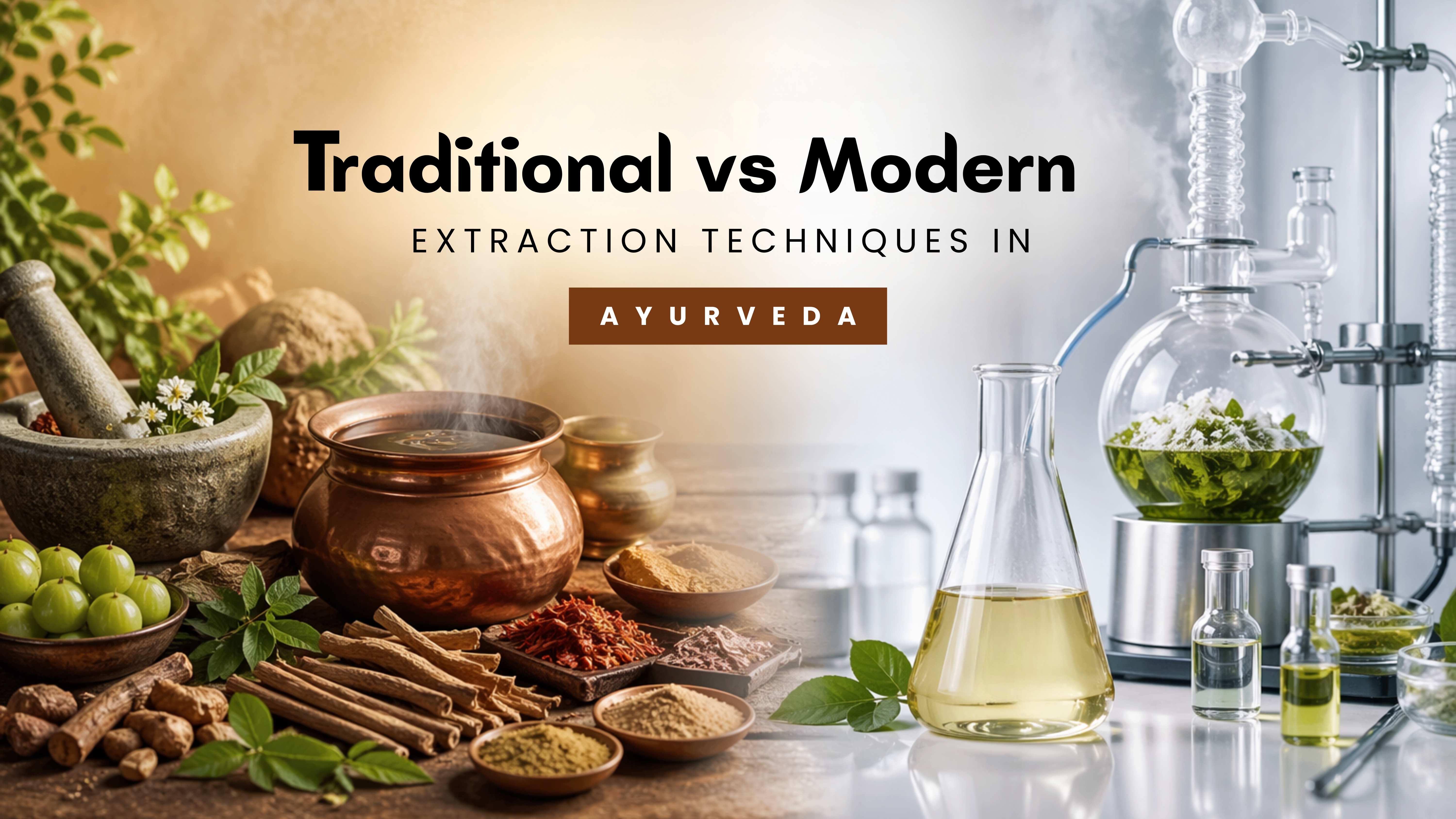
At Aadhunik Ayurveda, we carefully select extraction methods based on ingredient behavior.
For example:
Traditional Extraction
- Decoction (Kwath)
- Oil infusion (Taila preparation)
- Steam distillation for hydrosols
Modern Extraction
- Cold pressing
- Controlled solvent extraction
- Standardized botanical actives
The real strength lies in combining both methods.
Choosing the right extraction process is one of the most critical decisions in Ayurvedic product manufacturing, as it determines the concentration and stability of active herbal compounds.
Low Active Concentration: The Hidden Market Problem
Many Ayurvedic products fail simply because they contain too little active ingredient.
A product may highlight “Neem” or “Amla” on packaging, but the actual concentration may be too low to produce meaningful results.
From a manufacturing perspective, brands sometimes reduce active concentration to:
- Cut costs
- Improve texture
- Increase margins
This creates products that look Ayurvedic but perform weakly.
At Aadhunik Ayurveda, we prioritize clinically relevant and performance-driven herbal loading to maximize Ayurvedic product effectiveness.
Experienced private label Ayurvedic manufacturer partners prioritize performance-driven formulations with optimized active concentrations instead of creating products that only appear natural on the label.

Cheap Manufacturing Often Means Weak Formulations
Price pressure is one of the biggest reasons products underperform.
Many brands search for the cheapest manufacturer rather than the best manufacturer.
From a manufacturer’s standpoint, cheap production often means:
- Inferior ingredients
- Minimal R&D
- Weak testing protocols
Brands working with a certified third party Ayurvedic manufacturer India benefit from standardized quality systems, advanced testing protocols, and consistent manufacturing practices.
Cheap vs Quality Manufacturing
| Factor | Cheap Manufacturing | Premium Manufacturing |
|---|---|---|
| Ingredients | Low grade | Premium sourcing |
| Testing | Minimal | Stability & safety |
| Active concentration | Low | Optimized |
| Results | Inconsistent | Reliable |
This is why brands partnering with a trusted private label Ayurvedic manufacturer generally see better customer retention.
Lack of R&D Makes Products Ineffective
Ayurveda alone is not enough.
Traditional wisdom must be supported by modern research.
Without R&D:
- Formulations may become unstable
- Ingredients may clash
- Products may not penetrate effectively
At Aadhunik Ayurveda, R&D ensures:
- Ingredient compatibility
- Stability testing
- Real-world efficacy
Strong research is one of the reasons premium Ayurvedic products outperform poorly formulated alternatives.
Investment in research and innovation allows an Ayurvedic R&D manufacturer India to develop formulations that deliver measurable performance while maintaining the principles of traditional Ayurveda.
Consumer Misuse Also Plays a Major Role
Sometimes the issue is not the product, it is how it is used.
Examples include:
Hair Oils
Consumers expect overnight hair growth.
Reality:
Hair growth requires consistency for months.
Face Oils
Consumers overapply or combine with incompatible routines.
Herbal Cleansers
People expect foaming like synthetic face washes.
This misunderstanding contributes heavily to the perception of Ayurvedic products not working.
Marketing Claims vs Actual Product Reality
The Ayurvedic market is full of exaggerated promises.
Examples:
- Instant hair growth
- Overnight pigmentation removal
- Immediate acne cure
From a manufacturer’s perspective, exaggerated marketing damages trust.
At Aadhunik Ayurveda, we encourage realistic claims backed by ingredient science and traditional principles.

Standardization Matters More Than Most Brands Realize
Natural ingredients vary by:
From a manufacturer’s standpoint, airless systems:
- Climate
- Soil conditions
- Harvest timing
Without standardization:
Products become inconsistent.
A professional Ayurvedic skincare manufacturer India ensures:
- Batch consistency
- Active stability
- Ingredient testing
This improves repeat customer trust.
Maintaining batch-to-batch consistency is a hallmark of professional Ayurvedic contract manufacturing, ensuring consumers receive the same quality and performance every time they purchase the product.

Why Some Herbal Products Are Too Mild
Some formulations fail because brands intentionally make products too mild to avoid irritation.
This can result in:
- Slow performance
- Weak customer perception
- Reduced satisfaction
At Aadhunik Ayurveda, balancing efficacy and gentleness is a major part of formulation science.
The Role of Preservation in Product Performance
Poor preservation can destroy herbal products.
Water-based formulations containing:
- Aloe vera
- Herbal extracts
- Hydrosols
Need protection.
Without proper preservation:
- Microbial growth happens
- Formula breaks down
- Performance reduces
This is why responsible preservation supports Ayurvedic product quality.
How Aadhunik Ayurveda Ensures Products Actually Work
At Aadhunik Ayurveda, we focus on efficacy through:
1. Ingredient Integrity
Premium sourcing and strict testing.
2. Proper Extraction
Choosing extraction based on ingredient behavior.
3. Balanced Formulations
Traditional knowledge + scientific validation.
4. Stability Testing
Ensuring products remain effective over time.
5. Brand Education
Helping brands set realistic positioning.
This approach helps us build products that consumers trust.
Future of Effective Ayurvedic Products
The future of Ayurveda is not just traditional, it is evidence-based.
Emerging trends:
- Bioactive herbs
- Fermented Ayurveda
- Better delivery systems
- Clinical testing
Brands investing in research-driven Ayurveda will lead the market.
As consumer awareness continues to grow, brands that prioritize Ayurvedic product quality, ingredient transparency, and scientific formulation will build stronger customer trust and long-term market success.
Conclusion
When Ayurvedic products fail, it is rarely because Ayurveda itself does not work. The real reasons often include poor sourcing, weak formulations, low active concentration, bad extraction, unrealistic expectations, or weak manufacturing standards.
The effectiveness of Ayurveda depends heavily on who manufactures it and how seriously the process is handled.
At Aadhunik Ayurveda, we believe Ayurvedic products should not only sound natural, they should deliver meaningful results backed by traditional wisdom and scientific precision.
CTA: Build Effective Ayurvedic Products with Aadhunik Ayurveda
Want to create Ayurvedic products that customers genuinely trust and repurchase?
Partner with Aadhunik Ayurveda for:
- Premium herbal sourcing
- Strong R&D-backed formulations
- Effective active concentrations
- Quality manufacturing standards
- Export-ready Ayurvedic products
Build products that truly perform with Aadhunik Ayurveda.
FAQs:
1. Why do some Ayurvedic products fail to show results?
Poor ingredient quality, low active concentration, weak extraction methods, or unrealistic expectations are common reasons.
2. Do Ayurvedic products work slower than chemical products?
Often yes, because they focus on long-term balance rather than quick cosmetic fixes.
3. Can poor manufacturing reduce Ayurvedic effectiveness?
Absolutely. Ingredient sourcing, extraction, and R&D directly impact performance.
4. Are fresh herbs better than processed extracts?
In many cases, whole botanicals offer broader nutritional synergy than isolated compounds.
5. How long should consumers use Ayurvedic products?
Consistency matters. Many products require several weeks to months for visible results.
6. Why choose Aadhunik Ayurveda?
Because we combine authentic Ayurveda with modern scientific formulation to create products that actually perform.
7. Can private label Ayurvedic manufacturers improve product performance?
Yes. An experienced private label Ayurvedic manufacturer provides expert formulation development, quality ingredient sourcing, standardized manufacturing, and rigorous testing to create products with better performance and consistency.
8. How can brands improve the effectiveness of their Ayurvedic products?
Brands should partner with a trusted Ayurvedic manufacturer in India, invest in high-quality raw materials, use scientifically validated extraction methods, conduct stability testing, and prioritize research-driven formulation development for long-term product success.