Why International Brands Are Choosing Indian Ayurvedic Manufacturers
The Global Rise of Ayurveda in Modern Beauty and Wellness | Why India Has Become a Major Destination for Ayurvedic Manufacturing |Traditional Knowledge Meets Modern Manufacturing |Why International Brands Prefer Indian Ayurvedic Manufacturers | Formulation Development: What International Brands Actually Expect | The Importance of R&D in International Ayurvedic Manufacturing| Natural Ingredients Require Professional Quality Control|The global beauty and wellness industry is experiencing a significant shift toward natural, botanical, and traditional wellness solutions. Consumers across the USA, UK, Europe, Australia, the Middle East, and other international markets are increasingly interested in products that combine natural ingredients, transparent sourcing, traditional knowledge, and modern quality standards. Ayurveda, with its long history of using herbs, oils, roots, flowers, and plant-based ingredients, has become an important part of this global movement.
This growing demand is creating new opportunities for international brands that want to launch Ayurvedic skincare, haircare, wellness, and herbal personal-care products. However, developing these products successfully requires more than simply purchasing herbs and putting them into a bottle. Brands need formulation expertise, reliable ingredient sourcing, quality control, manufacturing infrastructure, documentation, packaging support, and export experience.
This is one of the reasons why more international brands are exploring Ayurvedic contract manufacturing India as a practical route for developing and producing their products.
From a manufacturer's perspective, India offers a unique combination of traditional Ayurvedic knowledge, botanical diversity, manufacturing expertise, skilled formulation teams, and comparatively flexible production capabilities. At Aadhunik Ayurveda, we see this change directly through the increasing interest from brands looking to develop Ayurvedic products for international consumers.
The decision to manufacture in India is not simply about manufacturing cost. For serious brands, the bigger question is whether the manufacturer can convert an Ayurvedic concept into a stable, consistent, market-ready product while maintaining the identity of the brand.
The Global Rise of Ayurveda in Modern Beauty and Wellness
Ayurveda is traditionally associated with India, but its influence is no longer restricted to the Indian market. International consumers are increasingly familiar with ingredients such as amla, turmeric, neem, ashwagandha, brahmi, bhringraj, sandalwood, rose, sesame oil, coconut oil, and numerous other botanicals.
The global consumer is also becoming more interested in the story behind a product. Instead of looking only at the finished bottle, consumers want to know:
- Where were the ingredients sourced?
- What type of extraction was used?
- Is the formulation transparent?
- Is the product suitable for their lifestyle?
- How was the product manufactured?
- Does the brand have a genuine connection with its ingredients?
This creates a strong opportunity for brands that can combine Ayurvedic heritage with modern product development.
From our perspective as a manufacturer, international demand is moving away from simply calling something "herbal." Brands increasingly want formulations that have a clear ingredient story, appropriate product positioning, stable performance, and a manufacturing process that can be explained transparently.
This is why Ayurvedic products for international markets require a different approach from simply copying a traditional formulation.
The formulation must respect Ayurvedic principles while also considering the expectations of the target market.
Why India Has Become a Major Destination for Ayurvedic Manufacturing
India has a natural advantage when it comes to Ayurvedic manufacturing because Ayurveda is deeply connected with the country's traditional knowledge, botanical resources, processing techniques, and established supply chains.
However, traditional knowledge alone does not make a manufacturer suitable for international brands.
From a manufacturer's perspective, the real advantage comes from combining traditional knowledge with modern manufacturing systems.
Indian manufacturers can provide access to:
- A wide range of botanical raw materials
- Experienced herbal formulation teams
- Traditional extraction knowledge
- Modern processing equipment
- Quality-control laboratories
- Flexible product development
- Private-label manufacturing capabilities
- Export-oriented documentation
- Different packaging formats
- Scalable production
At Aadhunik Ayurveda, we consider this combination particularly important. Our approach is not to position Ayurveda against modern science. Instead, we focus on using traditional botanical knowledge while applying appropriate modern manufacturing and quality-control practices.
This allows international brands to create products that feel authentically Ayurvedic while still being suitable for contemporary consumers.
Traditional Knowledge Meets Modern Manufacturing
One of the biggest reasons international brands approach Indian manufacturers is the ability to combine traditional Ayurvedic knowledge with modern product development.
Ayurveda provides a vast knowledge base regarding herbs, oils, roots, flowers, and traditional combinations. However, a commercial product requires additional considerations.
A formulation may need to be evaluated for:
- Physical stability
- Microbial quality
- Ingredient compatibility
- Packaging compatibility
- Texture and sensory characteristics
- Shelf-life expectations
- Manufacturing consistency
- Target-market requirements
From the manufacturer's perspective, this is where R&D becomes essential.
For example, a traditional herbal oil may work well in its original form, but an international brand may want to develop it into a lightweight facial oil, hair serum, cleansing oil, or premium treatment product.
The manufacturer's job is to understand the original concept and then develop a commercially practical format without unnecessarily removing the character that makes the Ayurvedic concept valuable.
Why International Brands Prefer Indian Ayurvedic Manufacturers
International brands have different reasons for choosing Indian manufacturers. Some are attracted by India's Ayurvedic expertise, while others are looking for formulation flexibility, ingredient access, or export support.
From our experience at Aadhunik Ayurveda, the decision usually comes from a combination of several factors rather than one single advantage.
1. Authentic Ayurvedic Formulation Expertise
One of India's strongest advantages is access to traditional Ayurvedic ingredient knowledge..
An experienced Indian manufacturer understands the characteristics of commonly used botanicals and oils and can guide brands regarding their appropriate use in different product formats.
This is particularly valuable for brands that want genuine Ayurvedic positioning rather than simply adding one botanical ingredient to a conventional formulation.
For example, a brand interested in developing an Ayurvedic facial oil may need guidance regarding:
- Selection of carrier oils
- Botanical extracts
- Infusion techniques
- Aroma profile
- Skin feel
- Stability
- Packaging
A manufacturer with Ayurvedic formulation experience can contribute throughout this process.
2. Access to Botanical Ingredients
India has a broad ecosystem for sourcing herbs, seeds, roots, flowers, oils, and other botanical ingredients.
For international brands, this can simplify the development of products based on ingredients that may otherwise be difficult to source consistently.
Some commonly used Ayurvedic ingredients include:
- Amla
- Neem
- Turmeric
- Bhringraj
- Brahmi
- Tulsi
- Ashwagandha
- Manjistha
- Rose
- Vetiver
- Sesame
- Coconut
- Castor
- Moringa
However, ingredient availability alone is not enough.
From a manufacturer's perspective, the more important question is whether the raw material can be sourced consistently and evaluated for quality.
At Aadhunik Ayurveda, ingredient sourcing is considered an important part of formulation development because natural materials can vary with cultivation, harvesting, season, geographical origin, storage, and processing.
3. Competitive Manufacturing Economics
Manufacturing cost is another factor influencing international sourcing decisions.
India can provide competitive manufacturing economics because of its established raw-material ecosystem, skilled workforce, manufacturing infrastructure, and large supplier network.
However, international brands should not evaluate an Indian manufacturer solely by the lowest quotation.
From our perspective, the actual cosmetic manufacturing cost should be considered together with:
- Formula quality
- Raw-material quality
- Packaging
- Testing
- Documentation
- Manufacturing process
- Minimum order quantity
- Product development
- Quality control
- Export requirements
A low manufacturing quotation may not always reflect the lowest overall business cost if it results in inconsistent quality, packaging issues, delayed production, or later reformulation.
For international brands, value should therefore be evaluated rather than price alone.
4. Flexible Private Label Development
Many international beauty businesses do not want to establish their own manufacturing facilities.
They want to focus on branding, marketing, retail distribution, and customer relationships while working with an experienced manufacturer for product development and production.
This is where a private label Ayurvedic manufacturer can become an important strategic partner.
Private-label development can allow brands to create products under their own brand identity while receiving manufacturing support for:
- Formulation
- Ingredient sourcing
- Product development
- Packaging
- Filling
- Labeling
- Quality control
- Production
- Export documentation
At Aadhunik Ayurveda, we work with brands that have different levels of product-development experience. Some approach us with a complete formulation concept, while others begin with only an idea such as "an Ayurvedic anti-aging facial oil."
Our role is to help translate that concept into a manufacturable product.
5. Lower Infrastructure Investment for International Startups
Building a manufacturing facility from the ground up requires substantial investment.
A brand would need to consider:
- Manufacturing equipment
- Production areas
- Storage facilities
- Quality-control laboratories
- Personnel
- Utilities
- Documentation systems
- Maintenance
- Regulatory requirements
For a startup or growing international brand, this may not be commercially practical.
Working with an established Indian manufacturer allows the brand to access existing manufacturing infrastructure without carrying the entire capital burden of establishing a production facility.
This is one reason Ayurvedic contract manufacturing India continues to attract interest from international businesses.
The brand can concentrate its investment on areas such as branding, product development, packaging, marketing, and distribution.
6. India's Strong Herbal Manufacturing Ecosystem
India's herbal manufacturing ecosystem extends beyond individual factories.
It includes:
- Farmers
- Botanical suppliers
- Oil processors
- Extract manufacturers
- Packaging suppliers
- Testing laboratories
- Formulation specialists
- Manufacturing facilities
- Export service providers
This connected ecosystem can make product development more efficient.
From a manufacturer's perspective, having reliable supplier relationships is especially important because formulation development often requires multiple iterations.
If a particular botanical is unavailable or inconsistent, the manufacturer needs to identify an appropriate solution without compromising the product concept.
7. Ability to Develop Different Product Categories
International brands are not interested only in traditional Ayurvedic medicines. Modern consumers are purchasing Ayurvedic-inspired products across many beauty and wellness categories.
Indian manufacturers can support development across categories such as:
Skincare
Facial oils, serums, creams, cleansers, masks, scrubs, toners, moisturizers, and herbal treatments.
Haircare
Hair oils, shampoos, conditioners, scalp treatments, hair masks, and herbal cleansing powders.
Body Care
Body oils, body butters, soaps, scrubs, balms, and moisturizing products.
Wellness
Herbal powders, botanical blends, and other wellness-oriented products, subject to applicable regulations and intended use.
This versatility gives international brands greater opportunities to develop complete product ranges rather than launching a single product.
Formulation Development: What International Brands Actually Expect
International brands generally expect more than a manufacturer who can simply follow a production formula.
They often want a partner who can participate in formulation development.
From a manufacturer's perspective, formulation development typically begins with understanding the brief.
The manufacturer may ask:
- Who is the target consumer?
- Which country will the product be sold in?
- What is the desired texture?
- What price segment is targeted?
- Which ingredients are important?
- Is the product water-based, oil-based, or powder-based?
- What packaging will be used?
- What claims does the brand want to communicate?
These questions help determine the formulation strategy.
A product intended for a hot and humid market may require different sensory characteristics from one intended for a cold and dry climate.
Similarly, a premium facial serum may require a different packaging and texture strategy from a mass-market body lotion.
For a deeper understanding of how research, formulation development, ingredient compatibility, stability, and testing influence Ayurvedic product development, read our guide on
The Importance of R&D in International Ayurvedic Manufacturing
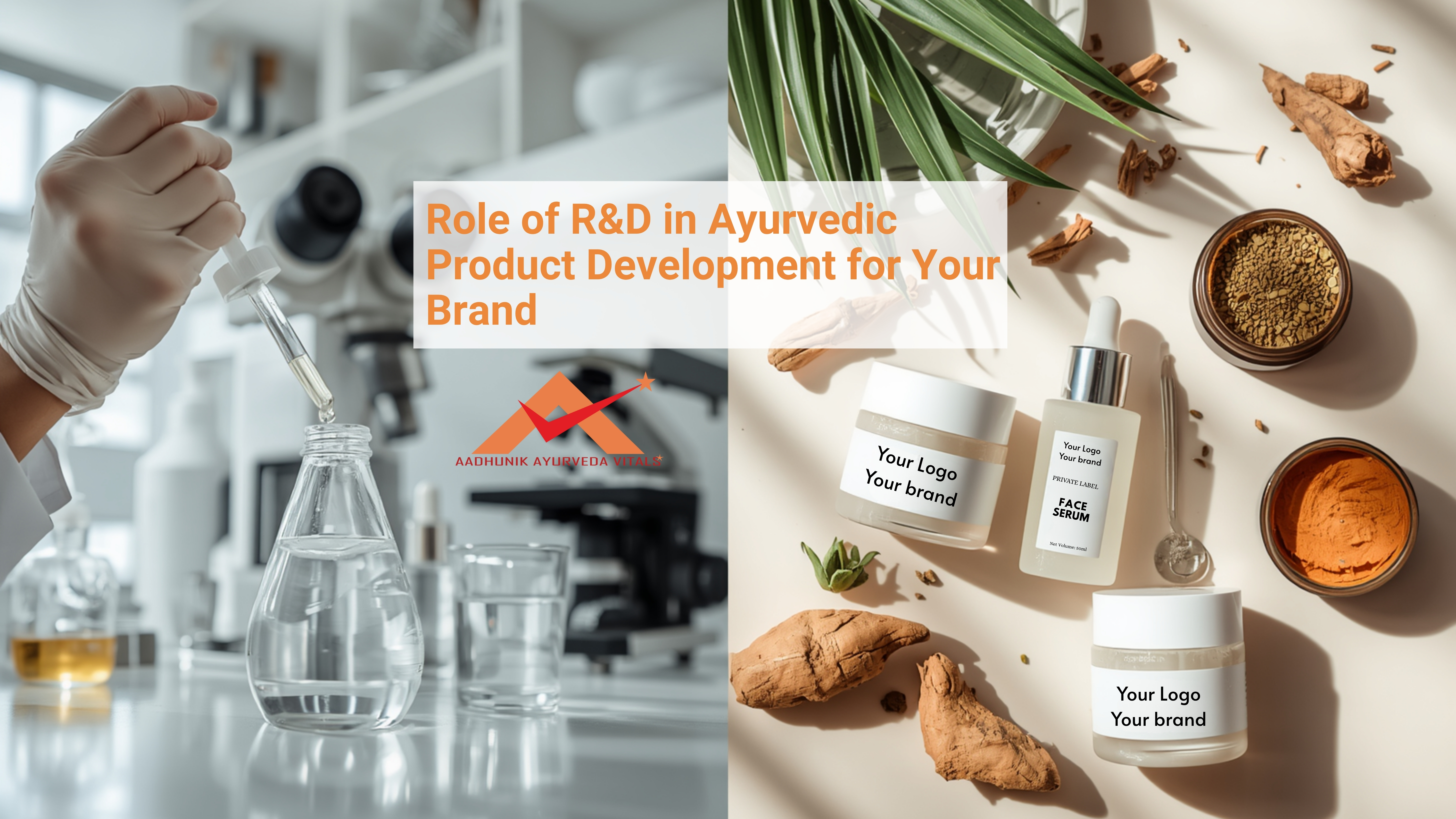
R&D is one of the most important differentiators between basic production and professional product development.
From our perspective at Aadhunik Ayurveda, R&D is responsible for answering practical questions before the product reaches consumers.
For example:
- Is the formulation physically stable?
- Are the ingredients compatible?
- Does the product maintain its appearance?
- Is the fragrance stable?
- Does the packaging interact with the formula?
- Is preservation appropriate where required?
- Does the product remain consistent between batches?
R&D may also help manufacturers modernize traditional formats.
A traditional herbal preparation might inspire a modern serum, oil, mask, cleanser, or treatment product.
The objective is not necessarily to change the traditional concept but to adapt it into a format that today's consumer can conveniently use.
Natural Ingredients Require Professional Quality Control
Natural does not automatically mean consistent.
This is an important point international brands should understand before selecting a manufacturer.
Botanical materials can vary due to:
- Soil conditions
- Climate
- Cultivation practices
- Harvesting period
- Plant maturity
- Drying conditions
- Storage
- Processing
From a manufacturer's perspective, quality control begins with raw materials.
A responsible manufacturing system should include appropriate evaluation and documentation before ingredients enter production.
This becomes especially important when brands market their products internationally, where customers increasingly expect ingredient transparency.
International brands can also explore how ingredient safety, formulation philosophy, natural ingredients, and modern consumer expectations influence skincare development in our guide on

Traceability Is Becoming More Important
International consumers increasingly want to understand where their ingredients originate.
For Ayurvedic brands, this is particularly valuable because the story behind an ingredient can become part of the brand's identity.
For example, a brand may want to communicate the botanical origin, traditional use, processing method, or sourcing philosophy of a particular ingredient.
At Aadhunik Ayurveda, we believe traceability should not be treated only as a marketing concept. It is also useful for manufacturing control.
Better traceability helps manufacturers understand:
- Where raw materials originated
- Which supplier provided them
- When they were received
- How they were processed
- Which production batch used them
This improves accountability throughout the manufacturing process.
Manufacturing Certifications and Quality Systems
International brands naturally want assurance that their manufacturing partner follows structured quality systems.
Certifications and manufacturing standards can provide evidence that a facility has established documented procedures and quality-management practices.
Depending on the product category and target market, brands may evaluate:
- GMP
- ISO standards
- Applicable Ayurvedic regulatory requirements
- Quality-control procedures
- Testing capabilities
- Manufacturing documentation
From a manufacturer's perspective, certifications should not be treated simply as logos for a website.
Their real value comes from the systems behind them.
A certification becomes meaningful when it is supported by consistent documentation, trained personnel, controlled manufacturing procedures, sanitation practices, testing, and quality checks.
Why Export Capability Matters
Manufacturing a product for the domestic market and manufacturing a product for international distribution can involve different considerations.
International brands may require:
- Product specifications
- Ingredient documentation
- Certificates of Analysis
- Safety-related documentation
- Batch records
- Packaging specifications
- Export documentation
- Country-specific information
This is where an experienced cosmetic export manufacturer can provide significant value.
At Aadhunik Ayurveda, we understand that export-oriented manufacturing requires planning from the beginning rather than adding documentation at the end of production.
The target country should be considered during product development because regulatory expectations, labeling requirements, claims, ingredients, packaging, and documentation can vary between markets.
Climate and Transportation Considerations
International products may travel through multiple climatic conditions before reaching their final destination.
A product manufactured in India could be transported through hot, humid, cold, or dry environments depending on the destination.
Packaging and formulation therefore need to be evaluated accordingly.
From the manufacturer's perspective, international product development should consider:
- Temperature exposure
- Humidity
- Light exposure
- Transportation duration
- Packaging durability
- Storage conditions
This is particularly important for natural formulations because botanical ingredients can be sensitive to environmental conditions.
Packaging Is Part of the Manufacturing Strategy
International brands increasingly understand that packaging is not just a branding decision.
The packaging must protect the formulation while also creating the desired consumer experience.
Depending on the formulation, manufacturers may recommend:
- Amber glass bottles
- Dropper bottles
- Airless pumps
- Cosmetic jars
- Spray bottles
- Pump bottles
- Tubes
- Specialized closures
For example, a sensitive botanical facial serum may require different packaging from a herbal body scrub.
At Aadhunik Ayurveda, we evaluate packaging according to formulation compatibility, stability, usability, branding, and transportation requirements.
How Indian Manufacturers Help Brands Scale
An international brand may begin with a relatively small launch quantity.
As demand grows, production requirements may increase significantly.
The manufacturer therefore needs to have systems capable of supporting growth.
From our perspective, scalability requires more than increasing the number of units produced.
It requires:
- Reliable raw-material sourcing
- Production planning
- Consistent manufacturing procedures
- Batch-to-batch quality control
- Packaging availability
- Storage capacity
- Workforce planning
A manufacturer that can support a brand from initial product development through larger commercial production becomes a long-term business partner rather than simply a supplier.
Minimum Order Quantity: Why It Matters to International Brands
Minimum order quantity, or MOQ, is an important consideration for international brands.
Startups generally want to minimize inventory risk, while established brands may require larger production volumes.
An appropriate MOQ can help brands manage:
- Initial investment
- Inventory
- Storage
- Cash flow
- Market testing
- Product launch risk
From the manufacturer's perspective, MOQ depends on factors such as formulation complexity, packaging, raw-material purchasing, filling requirements, and production economics.
A brand should therefore discuss MOQ early in the development process rather than assuming every product can be produced at the same quantity.
What International Brands Should Look for in an Indian Ayurvedic Manufacturer
Choosing the right manufacturer is perhaps the most important decision in the entire process.
International brands should evaluate the manufacturer beyond website claims.
A proper assessment should consider:
1. Manufacturing Infrastructure
Does the facility have appropriate production and storage systems?
2. R&D Capability
Can the manufacturer develop or modify formulations?
3. Quality Control
Are raw materials and finished products appropriately tested?
4. Ingredient Sourcing
Does the manufacturer have reliable botanical suppliers?
5. Documentation
Can the manufacturer provide appropriate product and batch documentation?
6. Export Experience
Does the manufacturer understand international business requirements?
7. Scalability
Can production increase as the brand grows?
8. Communication
Can the manufacturer communicate clearly throughout development and production?
What International Brands Should Evaluate
| Evaluation Area | What Brands Should Check | Why It Matters |
|---|---|---|
| R&D | Formulation development and testing | Product performance |
| Manufacturing | Infrastructure and processes | Batch consistency |
| Raw Materials | Quality and sourcing | Ingredient reliability |
| Quality Control | Testing and documentation | Consumer safety |
| Packaging | Compatibility and durability | Product protection |
| MOQ | Minimum production requirements | Inventory planning |
| Export Support | Documentation and experience | International distribution |
| Scalability | Production capacity | Long-term growth |
Indian Ayurvedic Manufacturing Is Not Just About Lower Cost
One of the biggest misconceptions about Indian manufacturing is that international brands choose India only because manufacturing is inexpensive.
Cost is certainly relevant, but it is not the only reason.
A serious brand also evaluates:
- Expertise
- Ingredient access
- Product development
- Quality
- Flexibility
- Manufacturing capacity
- Export readiness
- Communication
- Innovation
From our manufacturer's perspective, the real advantage of India is the combination of these capabilities.
A brand can potentially access traditional Ayurvedic expertise and botanical ingredients while also receiving modern manufacturing and R&D support.
The Role of Aadhunik Ayurveda in International Brand Development
At Aadhunik Ayurveda, our approach is built around supporting brands from concept to finished product.
We understand that international brands may not always have technical knowledge of Ayurvedic formulation. Some may know the exact product they want, while others may only have a market idea.
Our role is to bridge that gap.
We support brands with:
- Ayurvedic formulation development
- Botanical ingredient selection
- Product customization
- Private-label manufacturing
- Quality-control support
- Packaging solutions
- Product testing
- Batch production
- Export-oriented manufacturing support
Our objective is to create products that retain the identity of Ayurveda while meeting the practical expectations of modern consumers.
Why International Brands Choose Aadhunik Ayurveda
From our perspective, international partnerships work best when the manufacturer understands that every brand is different.
A UK skincare brand may have different requirements from a Middle Eastern wellness company. An Australian herbal brand may have a different consumer profile from a US clean-beauty startup.
Therefore, we do not believe in treating every project as an identical manufacturing order.
Instead, product development begins with understanding:
- Brand positioning
- Target market
- Consumer expectations
- Product category
- Ingredient preferences
- Packaging requirements
- Production quantity
This manufacturer-led approach helps create products that are more commercially relevant.
The Future of Ayurvedic Manufacturing for Global Markets
The future of Ayurveda in international markets is likely to move toward a combination of authenticity, transparency, scientific validation, and modern consumer convenience.
International consumers are increasingly interested in products that have a genuine ingredient story but are presented in formats that fit contemporary lifestyles.
This could mean:
- Lightweight Ayurvedic facial oils
- Herbal scalp serums
- Modern botanical cleansers
- Ayurvedic-inspired moisturizers
- Traditional herbal masks
- Waterless powder formulations
- Botanical hair treatments
- Premium wellness products
From a manufacturer's perspective, innovation will increasingly focus on how traditional Ayurvedic knowledge can be translated into practical modern products.
The Rise of Clean and Transparent Ayurvedic Beauty
Clean beauty is also influencing Ayurvedic product development.
However, clean beauty should not simply mean removing every synthetic ingredient from a formula.
From a manufacturer's perspective, the focus should be on creating products where every ingredient has a functional purpose and the formulation is safe, stable, and appropriate for its intended use.
This includes making informed decisions about:
- Preservation
- Packaging
- Extraction
- Ingredient sourcing
- Stability
- Product format
For example, water-based ready-to-use products generally require appropriate preservation systems because water can support microbial growth. On the other hand, certain oil-based or powder-based formats can be developed without conventional water-based preservation systems when their formulation and manufacturing conditions support it.
This is an important area where manufacturer expertise can help brands choose the right product philosophy.
Waterless and Powder-Based Ayurvedic Products
One emerging opportunity for international brands is waterless beauty.
Traditional Indian beauty practices have long used dry powders, herbs, ubtans, and botanical preparations that can be activated or mixed before use.
Modern brands can adapt these concepts into convenient formats such as:
- Herbal cleansing powders
- Face masks
- Ubtans
- Hair cleansing powders
- Powder exfoliants
- Botanical treatment blends
From a manufacturer's perspective, these formats can offer interesting formulation opportunities, particularly for brands targeting minimal-ingredient and low-water product concepts.
However, appropriate moisture control, packaging, microbiological quality, and storage conditions remain important.
Why Manufacturer-Brand Collaboration Matters
Successful product development is rarely a one-sided process.
The brand understands its consumer, positioning, story, and market.
The manufacturer understands:
- Formulation
- Manufacturing
- Ingredient behavior
- Packaging
- Testing
- Production
- Quality control
When these two perspectives are combined, the final product can become significantly stronger.
At Aadhunik Ayurveda, we consider communication with the brand an important part of manufacturing because a clear product brief can reduce unnecessary formulation changes and production delays.
Common Mistakes International Brands Make When Choosing a Manufacturer
International brands sometimes make manufacturing decisions based only on a few visible factors.
Choosing Only on Price
The cheapest quotation may not provide the best long-term value.
Ignoring R&D
A manufacturer may be able to produce a formula but may not provide meaningful product-development support.
Not Checking Ingredient Quality
Natural ingredients require proper sourcing and quality evaluation.
Failing to Discuss MOQ
Unexpected production quantities can affect budgets and inventory.
Ignoring Packaging Compatibility
The right formula in the wrong package can create stability and usability problems.
Waiting Until the End to Discuss Export Requirements
International requirements should be considered during formulation and packaging development.
A Manufacturer's Step-by-Step Approach for International Brand Projects
From our perspective, a successful international manufacturing project generally follows a structured process.
Step 1: Understand the Brand Brief
We first understand the product concept, target market, consumer, price segment, and positioning.
Step 2: Evaluate Ingredients
The requested botanicals and other ingredients are reviewed for suitability, availability, and formulation compatibility.
Step 3: Develop the Formula
The R&D team works toward creating a formulation that balances the brand concept with performance and stability requirements.
Step 4: Evaluate Packaging
The appropriate container and dispensing mechanism are selected based on the formulation.
Step 5: Testing and Validation
The product undergoes relevant quality and stability evaluations.
Step 6: Production Planning
Once the formula and packaging are finalized, raw materials and production requirements are planned.
Step 7: Manufacturing
The product is manufactured under controlled procedures with appropriate quality checks.
Step 8: Documentation and Dispatch
The required product documentation and export-related requirements are completed before dispatch.
Why India Will Remain Important for Global Ayurvedic Brands
The global Ayurvedic market is still evolving, and international consumers are becoming more familiar with traditional Indian ingredients and wellness philosophies.
India's position is strengthened by its combination of:
- Ayurvedic heritage
- Botanical resources
- Skilled manufacturing professionals
- R&D capabilities
- Established herbal supply chains
- Product-development flexibility
- Competitive production economics
- Growing export infrastructure
For international brands, this creates an opportunity to develop products that are authentically connected to Ayurveda while being designed for modern global consumers.
Conclusion
International brands are choosing Indian Ayurvedic manufacturers for reasons that go far beyond manufacturing cost. India offers a combination of traditional Ayurvedic knowledge, botanical ingredient access, formulation expertise, modern manufacturing capabilities, flexible product development, and export-oriented support.
From a manufacturer's perspective, the strongest opportunity lies in combining these advantages rather than treating Ayurveda and modern manufacturing as separate worlds.
A successful Ayurvedic product requires the right ingredient, the right formulation, the right extraction approach, the right packaging, appropriate testing, consistent manufacturing, and a clear understanding of the target market.
This is why selecting the right manufacturing partner is so important.
At Aadhunik Ayurveda, we believe international Ayurvedic manufacturing should be built around authenticity, quality, transparency, innovation, and long-term collaboration. Our objective is not simply to manufacture products for international brands but to help translate Ayurvedic concepts into commercially relevant products for modern global consumers.
As demand for natural and botanical beauty continues to grow, Indian Ayurvedic manufacturers have an important role to play in shaping the next generation of global skincare, haircare, wellness, and personal-care products.
CTA: Build Your Global Ayurvedic Brand with Aadhunik Ayurveda
Turn Your Ayurvedic Product Concept into a Global-Ready Bran
Planning to launch an Ayurvedic skincare, haircare, wellness, or herbal product for an international market?
Partner with Aadhunik Ayurveda, an Indian Ayurvedic manufacturer supporting brands with formulation, manufacturing, ingredient sourcing, packaging, quality control, and export-oriented product development.
What You Get
- Ayurvedic formulation and R&D support
- Premium botanical ingredient sourcing
- Private-label manufacturing
- Customized product development
- Quality-control support
- Packaging solutions
- Scalable manufacturing
- Export-oriented manufacturing support
Bring your product concept to us and develop an Ayurvedic product designed for today's global consumer.
FAQs:
1. Why are international brands choosing Indian Ayurvedic manufacturers?
From our perspective, international brands choose Indian manufacturers because India offers a combination of Ayurvedic formulation expertise, botanical ingredient availability, manufacturing infrastructure, R&D capabilities, flexible production, and export support.
2. Is Indian Ayurvedic manufacturing suitable for international skincare brands?
Yes. Indian manufacturers can develop Ayurvedic skincare products for international markets, provided the formulation, ingredients, labeling, documentation, testing, and packaging are appropriately developed for the destination market.
3. What does Ayurvedic contract manufacturing in India involve?
Ayurvedic contract manufacturing India can involve formulation development, raw-material sourcing, manufacturing, quality control, packaging, labeling, testing, documentation, and production according to the brand's requirements.
4. Can Aadhunik Ayurveda manufacture customized Ayurvedic products??
Yes. At Aadhunik Ayurveda, we work with brands that require customized Ayurvedic skincare, haircare, wellness, and herbal products. Customization can involve formulation, ingredients, texture, packaging, and product positioning.
5. What should an international brand check before choosing an Indian manufacturer?
We recommend evaluating the manufacturer's R&D capabilities, manufacturing infrastructure, quality systems, raw-material sourcing, testing procedures, MOQ, documentation, packaging capabilities, scalability, and international-market experience.
6. Can Indian manufacturers support small international brands?
Yes. The appropriate manufacturer can support startups and emerging brands through flexible product-development and manufacturing solutions. MOQ, however, depends on formulation, packaging, raw materials, and production requirements.
7. How important is R&D when manufacturing Ayurvedic products?
R&D is extremely important. From a manufacturer's perspective, R&D helps evaluate formulation stability, ingredient compatibility, texture, preservation requirements where applicable, packaging compatibility, and overall product performance.
8. Can Aadhunik Ayurveda help with export-ready cosmetic products?
Yes. We support brands developing products for international markets by considering formulation requirements, packaging, product documentation, quality control, and export-oriented manufacturing needs from the development stage.
9. Does manufacturing in India mean compromising on quality?
No. Manufacturing quality depends on the individual facility, its quality systems, raw-material sourcing, manufacturing controls, testing, and R&D practices, not simply on the country where the product is manufactured.
10. Why is India becoming important for the global Ayurvedic beauty industry?
India has a unique combination of Ayurvedic heritage, botanical resources, experienced formulation professionals, established herbal supply chains, and modern manufacturing capabilities. This makes India an important manufacturing destination for brands looking to develop authentic Ayurvedic products for global consumers.
11. How does Aadhunik Ayurveda approach international brand projects?
We begin by understanding the brand's concept, target consumer, product category, market, and formulation requirements. From there, our manufacturing and R&D approach focuses on developing a practical, stable, scalable, and commercially relevant product rather than simply producing a standard formula.
12. Why should international brands work with an experienced Ayurvedic manufacturer instead of sourcing ingredients independently?
Sourcing individual ingredients does not automatically result in a commercially successful product. An experienced manufacturer brings together formulation expertise, ingredient evaluation, processing, testing, packaging compatibility, production control, and documentation. This integrated approach can significantly simplify product development for an international brand.