How to Build a Successful Skincare Brand with Private Label Manufacturing
Understanding Private Label Skincare Manufacturing in Professional Terms | Defining the Brand Identity Before Selecting Products | 3 Brand Identity Factors to Establish Early: | Selecting the Right Product Range | Selecting the Manufacturer – A Critical Determinant of Brand Success | Packaging, Label Architecture & Market PresentationBuilding a skincare brand today is not simply about placing a label on a jar and entering the market. The skincare industry has evolved into a science-driven, regulatory-bound, consumer-aware segment where credibility and performance matter more than packaging alone. Many entrepreneurs approach skincare with passion but are challenged by technical, manufacturing, and compliance complexities. This is where private label manufacturing becomes the strategic backbone of modern skincare brand development.
In fact, partnering with a private label skincare manufacturer in India or globally recognized custom skincare manufacturing companies allows founders to enter the market with confidence and reduced risk.
As a manufacturer, we work with founders, dermatologists, laboratories, retail chains, salons, and wellness startups, and we observe that the brands that succeed are those that pay attention to formulation quality, consistency, product positioning, and long-term market identity, not just marketing aesthetics.
Private label skincare manufacturing provides the foundation to build a strong and scalable skincare brand without requiring the founder to invest in laboratories, R & D teams, raw material procurement, formulation development, testing equipment, certifications, or manufacturing facilities.
This model is widely adopted in low investment skincare business startups and private label cosmetic brand development due to its cost efficiency and scalability.
Instead, the manufacturer provides the formulations, production capability, quality testing, and regulatory support, while the brand focuses on defining identity, packaging, communication, and customer acquisition. This division of roles is what allows new brands to enter the market efficiently, economically, and with high-quality products that are already tested and stable.
Understanding Private Label Skincare Manufacturing in Professional Terms
Private label manufacturing means that the formulations are already developed, tested, quality-controlled, and proven stable by the manufacturer. The brand selects from these formulations and customizes aspects such as fragrance, ingredients, packaging, and label design as needed.
This approach supports ready-to-launch skincare formulations and fast product development for skincare brands, reducing time-to-market significantly.
This ensures rapid product development because the core formula does not need to be created from scratch. For new founders, this eliminates uncertainty regarding how ingredients interact, what the product texture should be, how pH stability behaves, or how the formulation reacts under long-term storage conditions.
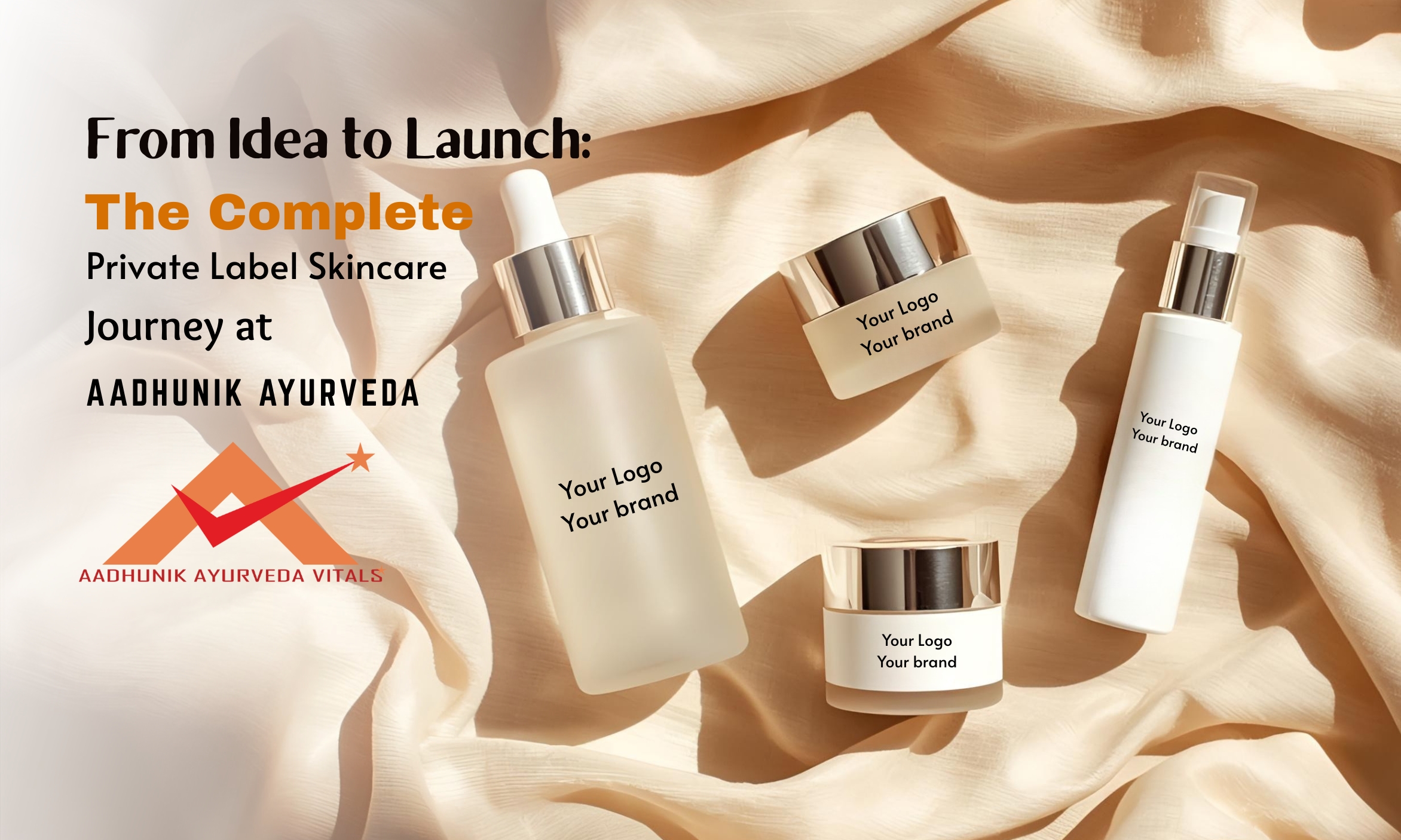
Key points to note in private label systems:
- The formulation is scientifically validated before the brand chooses it.
- Shelf life and microbial stability are already tested.
- Manufacturing conditions are standardized under compliance frameworks.
This ensures that the brand enters the market with credibility and consistency, which are fundamental in skincare.
Defining the Brand Identity Before Selecting Products
Before a product lineup is chosen, the brand identity must be clearly defined. Markets are crowded; customers compare ingredient lists, skin suitability, environmental claims, price points, and brand belief systems.
This is where skincare brand positioning strategy and beauty brand identity development play a critical role in long-term success.
Therefore, the founder must decide what type of skincare brand they intend to build. Whether the identity focuses on minimalist formulations, Ayurvedic and botanical skincare, dermatologist-derived medical skincare, aroma-based spa wellness, or luxury clean beauty retail, the approach influences product selection, packaging style, pricing, and marketing communication.
3 Brand Identity Factors to Establish Early:
- Target Audience Behavior – skin concerns, purchasing capacity, demographic preferences.
- Product Philosophy – natural, clinical, luxury, organic, or hybrid formulation.
- Positioning Level – accessible affordable daily care vs. aspirational premium segment.
Without this clarity, product selection becomes scattered, and the brand message becomes weak.
Selecting the Right Product Range
A successful launch rarely starts with 15–20 SKUs. It starts with a well-structured, purpose-driven product lineup, often between 3 to 6 products, that communicates the brand philosophy clearly.
This approach is widely recommended in skincare startup product strategy and minimum viable product (MVP) for beauty brands.
A strong core range should cover basic skincare steps such as cleansing, hydration, treatment, and nourishment. This allows the consumer to experience a complete routine rather than a single product without context. Once the market responds positively, additional variants and specialized treatments may be introduced.
A standard, stable, and strategic starter range may include:
- A cleanser or micellar fluid appropriate for the chosen skin segment
- A hydrosol mist, toner, or water-phase hydration base
- A serum or facial treatment oil for targeted results
- A moisturizer or emulsion as the sealing and nourishing layer
This is not just about offering products; it is about offering a system that builds habit and trust.
Selecting the Manufacturer – A Critical Determinant of Brand Success
Choosing the right manufacturer is one of the most strategic business decisions. A brand’s reputation is only as strong as the quality and consistency of its product batches.
Working with a GMP certified skincare manufacturer or ISO certified cosmetic manufacturer ensures regulatory compliance and product safety.
Therefore, evaluation must move beyond price comparisons and toward assessing capability, certifications, ingredient sourcing transparency, equipment standards, documentation systems, and scalability support.
What a strong manufacturer provides:
- GMP or ISO-certified production standards
- Controlled sourcing of raw materials with traceability
- Stability and microbiological testing reports
- Ability to replicate batch quality consistently
- Customization support if required in the future
Brands that choose manufacturers only on the basis of low pricing often struggle with inconsistent product texture, fragrance variations, shorter shelf life, and customer dissatisfaction, which are damaging to brand trust.

Packaging, Label Architecture & Market Presentation
Packaging is not just visual. It is functional, regulatory, and brand-defining. For skincare, the packaging must protect the formulation, prevent contamination, and maintain stability.
Using cosmetic packaging solutions for skincare brands and sustainable beauty packaging materials enhances both product safety and brand perception.
Material selection, glass, PET, aluminum, airless pump, or amber protective containers, must be aligned with formula sensitivity. Labeling must follow cosmetic regulatory requirements regarding ingredient listing, manufacturing details, warnings, and shelf life.
A well-presented product gains consumer trust before it is even opened.
Pricing Strategy and Value Positioning
Pricing is not determined only by ingredient cost. It reflects perceived value.
A strong skincare pricing strategy combined with premium beauty brand positioning helps brands maintain profitability and customer trust.
If your brand positions itself as clean, premium, science-backed, or Ayurvedic, the price must communicate that value. Undervaluing products leads to brand dilution, reduced trust, and poor scalability. Smart pricing balances feasibility for the customer and sustainable growth for the brand.
Marketing and Market Penetration Strategy
The product is only one part of the equation. The market must understand why the product exists.
Effective skincare digital marketing strategies and ingredient-based content marketing help build trust and long-term customer engagement.
A strategic brand will prepare educational content, comparison insights, ingredient transparency explanations, skin suitability guidance, and real demonstration testing. The focus is not simply to sell, but to prove value and build trust. A product that is understood is a product that is adopted.
Conclusion - Private Label Manufacturing Enables Strategic Brand Building
Private label manufacturing does not simplify brand building, it strengthens it by removing technical barriers and allowing the founder to focus on identity, consumer relationships, and growth strategy.
Brands leveraging private label skincare solutions and end-to-end cosmetic manufacturing services scale faster with reduced operational complexity.
When the product foundation is scientifically strong and manufacturing is consistent, the brand gains trust more rapidly. With clarity of purpose, strategic product selection, professional manufacturing partnerships, and disciplined brand communication, a skincare brand can scale sustainably and meaningfully in today’s competitive beauty market.
FAQs:
Do I need my own formulas to start a skincare brand?
No. Private label formulations are ready, tested, and safe to launch.
Can I start with small batches?
Yes, depending on MOQ policies, small-batch launches are possible.
How long does the manufacturing process take?
Typically 4–12 weeks depending on customization and packaging.
Can formulas be customized later?
Yes, once the brand stabilizes, customization can be added strategically.
Are private label products safe?
Yes, when manufactured under GMP/ISO conditions with proper testing.
What is private label skincare manufacturing and how does it help startups?
Private label manufacturing allows startups to launch products using pre-developed, tested formulations. It is widely used in low investment skincare brand startups and helps reduce time, cost, and R & D effort significantly.
How do I choose the best private label skincare manufacturer?
Choose a manufacturer with certifications, testing facilities, and transparent sourcing. Working with a trusted private label skincare manufacturer ensures product quality, compliance, and long-term brand success.
Call to Action
If you are planning to launch your skincare brand and want a reliable production partner, we can help with formulation selection, packaging guidance, and batch manufacturing. Our private label system makes it easier to start with safe, tested, and market-ready products.
Reach out to us to discuss your product idea and launch plan.
We’ll guide you step-by-step from concept to finished product.