Ayurvedic Private Label Manufacturing: Cost Breakdown & MOQ Guide
How much does Ayurvedic private label manufacturing actually cost? |What should my minimum order quantity (MOQ) be? |Understanding Private Label Ayurvedic Manufacturing | Why More Brands Are Choosing Private Label Manufacturing | Why Cost Should Never Be the First Decision| What Determines Cosmetic Manufacturing Cost?|A Complete Manufacturer's Guide for Brands Looking to Build an Ayurvedic Business
The Ayurvedic industry has evolved far beyond traditional wellness products. Today, it represents one of the fastest-growing sectors in skincare, haircare, personal care, nutraceuticals, and wellness across domestic as well as international markets. Consumers are actively searching for natural, transparent, and scientifically developed formulations, encouraging entrepreneurs and established companies alike to launch their own Ayurvedic brands.
However, while starting an Ayurvedic brand has become more accessible than ever before, one question continues to dominate conversations between manufacturers and brand owners:
"How much does Ayurvedic private label manufacturing actually cost?"
Closely followed by another equally important question:
"What should my minimum order quantity (MOQ) be?"
From a manufacturer's perspective, these two questions cannot be answered with a single number. Every formulation, ingredient, packaging style, manufacturing process, testing requirement, and branding decision influences the final production cost.
At Aadhunik Ayurveda, we work with startups, D2C brands, exporters, wellness companies, pharmacies, retailers, and international distributors every day. One thing we consistently observe is that many new brands focus only on manufacturing price while overlooking several other factors that directly affect product quality, long-term profitability, and scalability.
Understanding Private Label Ayurvedic Manufacturing
Private label manufacturing allows businesses to launch their own branded Ayurvedic products without establishing their own manufacturing facility.
Instead of investing millions of dollars in land, machinery, laboratory equipment, regulatory approvals, and technical teams, brands collaborate with an experienced manufacturer who develops, manufactures, tests, packages, and often even helps commercialize products.
From a manufacturer's standpoint, private label manufacturing is not simply about producing products. It is about transforming a business idea into a scalable commercial brand.
At Aadhunik Ayurveda, every private label project begins by understanding the client's business goals rather than immediately discussing formulations.
Before manufacturing begins, we evaluate:
- Target customer segment
- Product category
- Pricing strategy
- Domestic or export markets
- Expected production volumes
- Brand positioning
Only after understanding these factors do we recommend suitable formulations and manufacturing strategies.
This customer-first approach allows brands to optimize both quality and cosmetic manufacturing cost simultaneously.
Why More Brands Are Choosing Private Label Manufacturing
Launching a manufacturing facility independently requires enormous investment and years of regulatory preparation.
Private label manufacturing removes these barriers while allowing entrepreneurs to focus on building their brands.
From our experience at Aadhunik Ayurveda, businesses choose private label Ayurveda manufacturer India partnerships because they receive immediate access to:
- Experienced formulation scientists
- Certified manufacturing infrastructure
- Quality control laboratories
- Regulatory documentation
- Packaging expertise
- Commercial production capabilities
Instead of spending years building infrastructure, brands can concentrate on marketing, customer acquisition, product positioning, and business expansion.
Why Cost Should Never Be the First Decision
One of the biggest misconceptions we encounter is that manufacturing cost alone determines profitability.
Many brands compare quotations from different manufacturers and automatically select the lowest price.
From a manufacturer's perspective, this can become an expensive mistake.
Lower manufacturing costs sometimes result from:
- Inferior raw materials
- Limited quality testing
- Poor packaging
- Lower active ingredient concentration
- Inconsistent batch quality
- Minimal R&D investment
While the initial quotation may appear attractive, long-term product performance and customer satisfaction often suffer.
At Aadhunik Ayurveda, we encourage brands to evaluate overall manufacturing value instead of focusing exclusively on price.
What Determines Cosmetic Manufacturing Cost?
Manufacturing cost is not determined by one single factor.
Instead, it is influenced by multiple components working together throughout the production process.
Some of the largest contributors include:
1. Raw Material Quality
Raw materials usually represent one of the largest portions of production cost.
Premium botanical ingredients naturally cost more because they require:
- Careful cultivation
- Ethical harvesting
- Quality testing
- Controlled storage
For example, organically cultivated herbs generally cost more than conventionally sourced ingredients.
Similarly, cold-pressed carrier oils are more expensive than refined alternatives.
At Aadhunik Ayurveda, ingredient quality is never compromised simply to reduce manufacturing cost.
2. Formulation Complexity
Simple herbal oils require fewer manufacturing steps than advanced emulsions or multi-active serums.
For example:
A single-herb oil formulation requires relatively straightforward processing.
However, a premium face serum containing multiple botanical extracts, peptides, antioxidants, emulsifiers, stabilizers, and fragrance compatibility requires considerably more laboratory work.
As formulation complexity increases, cosmetic manufacturing cost also increases.
3. Research & Development
Many startups underestimate the importance of formulation development.
Before commercial manufacturing begins, R&D teams often spend weeks or months optimizing:
- Texture
- Stability
- Fragrance compatibility
- Active ingredient balance
- Product appearance
- Shelf life
This investment ensures consistent product quality throughout commercial production.
At Aadhunik Ayurveda, R&D is viewed as an investment rather than an expense because it reduces long-term manufacturing risks.
4. Packaging Selection
Packaging significantly influences total manufacturing cost.
Consumers often purchase products based on visual appeal before experiencing formulation performance.
Packaging decisions include:
- Bottle material
- Jar design
- Pump mechanisms
- Airless systems
- Labels
- Cartons
- Printing quality
Premium glass packaging naturally costs more than standard PET bottles.
Similarly, luxury boxes increase overall production expenses.
However, premium packaging may also improve perceived product value.
Major Cost Components in Ayurvedic Manufacturing
| Cost Component | Impact on Overall Cost | Manufacturer's Perspective |
|---|---|---|
| Raw materials | High | Never compromise ingredient quality |
| Product formulation | Medium–High | Better R&D creates better products |
| Packaging | Medium | Influences customer perception |
| Quality testing | Medium | Essential for safety and consistency |
| Regulatory documentation | Medium | Important for market compliance |
| Manufacturing process | Medium | Depends on equipment and production scale |
From a manufacturer's perspective, balancing these components is far more important than minimizing individual expenses.
Understanding MOQ in Ayurvedic Manufacturing
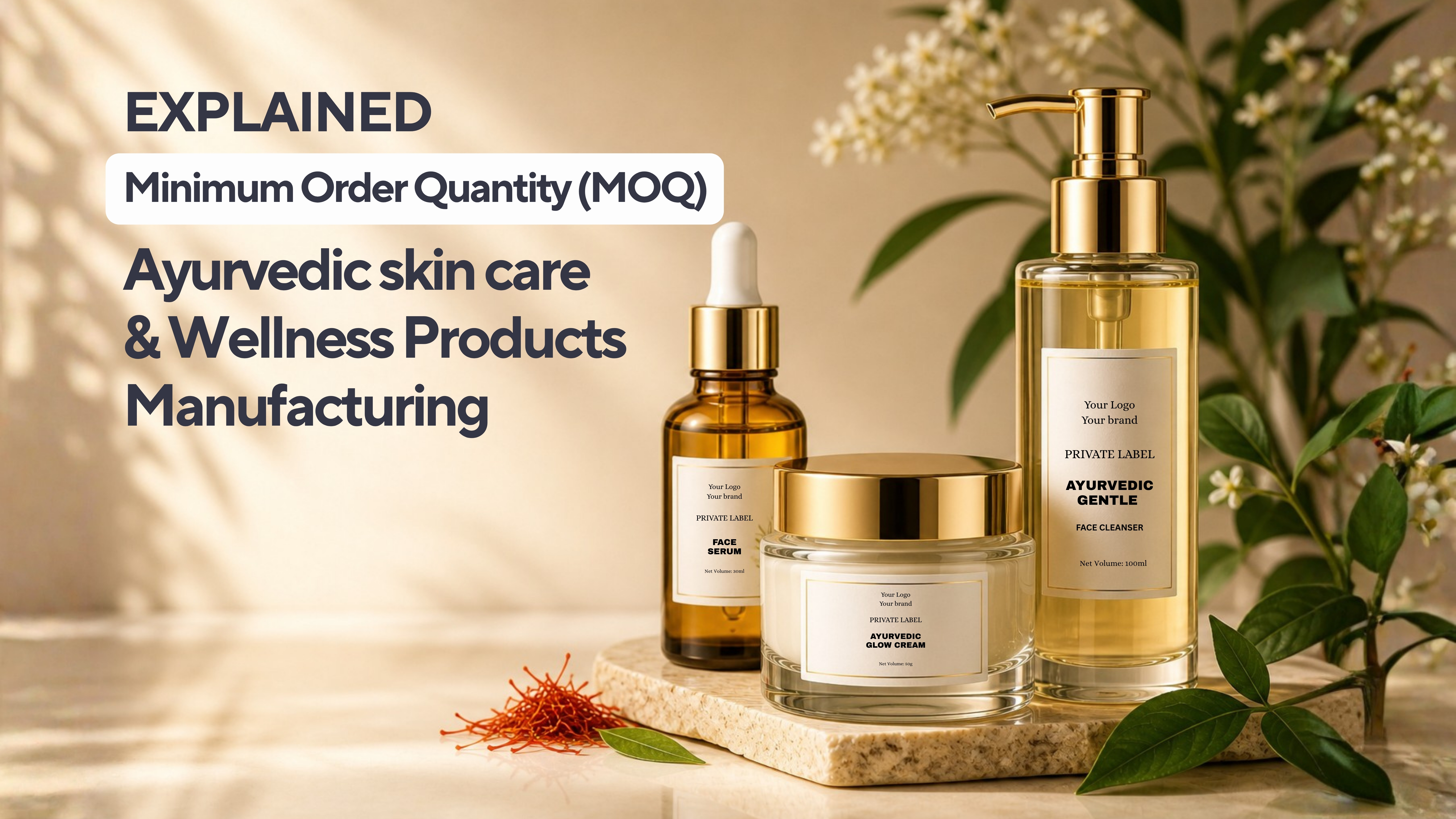
MOQ stands for Minimum Order Quantity.
It represents the minimum production quantity required for a manufacturer to produce a product efficiently.
Many new entrepreneurs misunderstand MOQ as an arbitrary number decided by manufacturers.
In reality, MOQ exists because manufacturing involves fixed operational costs that remain similar regardless of production size.
These include:
- Equipment setup
- Machine cleaning
- Production planning
- Quality testing
- Batch documentation
- Workforce allocation
Producing 100 bottles often requires almost the same preparation as producing 2,000 bottles.
This is why MOQ helps manufacturers maintain production efficiency while keeping costs reasonable.
Why Manufacturers Cannot Always Offer Extremely Low MOQ
Startups frequently request production quantities as low as 50 or 100 units.
While understandable from a business perspective, such small batches often become economically impractical.
From a manufacturer's viewpoint, every production batch requires:
- Raw material verification
- Machine setup
- Laboratory approval
- Batch manufacturing records
- Cleaning validation
- Quality inspections
These fixed activities consume time regardless of production volume.
Therefore, manufacturers recommend MOQs that balance operational efficiency with startup affordability.
At Aadhunik Ayurveda, we strive to offer flexible MOQ options wherever technically feasible while maintaining consistent product quality.
Why MOQ Varies Between Products
MOQ is not the same for every Ayurvedic product.
Several factors influence minimum production quantities.
These include:
- Product category
- Packaging availability
- Ingredient cost
- Manufacturing complexity
- Filling process
- Regulatory requirements
For example, herbal powders often allow smaller production batches compared to complex emulsified creams requiring specialized processing equipment.
Hidden Costs That Many Brands Overlook
One of the biggest reasons new Ayurvedic brands struggle with budgeting is that they focus only on the product quotation while ignoring several additional expenses that arise during development and commercialization.
From a manufacturer’s perspective, these hidden costs can significantly affect overall profitability if they are not planned in advance.
Commonly overlooked expenses include:
- Product photography and content creation
- Packaging design and artwork development
- Barcode generation
- Regulatory labeling updates
- Freight and logistics
- Secondary packaging for e-commerce shipping
- Product sampling and prototype revisions
At Aadhunik Ayurveda, we often advise startups to allocate an additional budget for these activities because they directly influence market readiness.
Ignoring them can lead to delays even after manufacturing is completed.
Export Manufacturing: Why Costs Are Different
Brands planning international expansion through private label Ayurveda manufacturer India partnerships must understand that export-ready products involve additional requirements.
Export manufacturing may include:
- Country-specific labeling compliance
- Additional stability testing (country specific compliance, if any)
- Ingredient documentation (common & INCI)
- MSDS and safety reports ( for transit and otherwise handling)
- Export cartons/packaging
- Special packaging standards
- International shipping coordination
These factors naturally increase cosmetic manufacturing cost, but they also make products eligible for international markets.
At Aadhunik Ayurveda, export readiness is integrated into product development with some exceptions whenever a brand intends to expand globally.
How Packaging Can Change Your Manufacturing Budget
Packaging is often one of the most underestimated cost drivers.
For example:
| Packaging Type | Cost Impact |
|---|---|
| Standard PET bottle | Low |
| Amber glass bottle | Medium |
| Frosted glass bottle | High |
| Airless pump system | High |
| Luxury printed carton | Additional premium |
From a manufacturer’s standpoint, packaging should match brand positioning.
A premium Ayurvedic serum targeting international markets may justify higher packaging investment, while a mass-market hair oil may prioritize cost efficiency.
How Brands Can Reduce Manufacturing Cost Without Compromising Quality
Reducing cost does not always mean reducing quality.
At Aadhunik Ayurveda, we help brands optimize production through strategic decisions.
Cost optimization strategies include:
- Using standardized packaging components
- Consolidating product variants
- Planning larger production batches
- Selecting efficient filling formats
- Reducing unnecessary packaging layers
- Using multi-functional botanical ingredients
For example, a formulation containing a carefully selected combination of herbs may eliminate the need for multiple expensive specialty extracts.
This improves both formulation simplicity and manufacturing efficiency.
The Relationship Between MOQ and Per-Unit Cost
One of the most important concepts brands must understand is that higher production volumes usually reduce per-unit manufacturing cost.
Why?
Because fixed expenses such as machine setup, testing, and documentation are distributed across more units.
For example:
| Production Quantity | Estimated Per-Unit Cost Trend |
|---|---|
| 500 units | Highest |
| 1,000 units | Lower |
| 2,000 units | Moderate |
| 5,000+ units | More economical |
From a manufacturer's perspective, MOQ planning should align with realistic sales projections rather than simply choosing the lowest possible quantity.
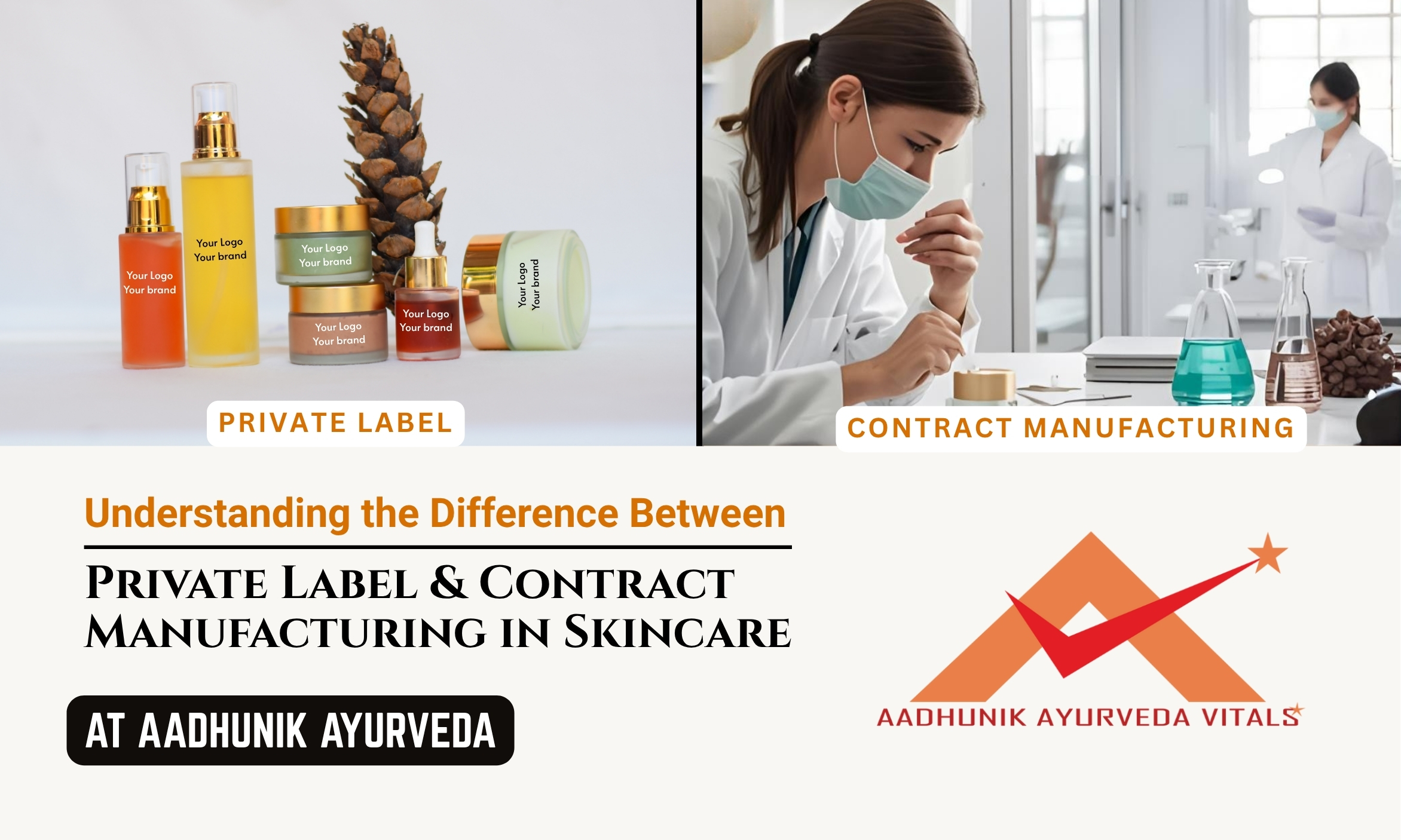
Private Label vs Contract Manufacturing: Cost Perspective
Many entrepreneurs confuse private label and contract manufacturing.
In a private label Ayurveda manufacturer India model, brands often start with existing or semi-customized formulations, which can reduce development costs and speed up launch timelines.
In a fully customized contract manufacturing model, additional expenses may arise from:
- Extensive R&D
- Multiple prototype revisions
- Unique ingredient sourcing
- Specialized testing
- Custom packaging molds
For startups, private label manufacturing is often the most cost-effective entry point.
Common Mistakes Startups Make
From our experience at Aadhunik Ayurveda, several mistakes repeatedly increase manufacturing expenses unnecessarily.
Mistake 1: Launching Too Many Products
Many new brands try to launch 25 and beyond products immediately.
Instead, starting with 10-15 strong products usually reduces inventory risk and simplifies manufacturing.
Mistake 2: Constant Formula Changes
Frequent formulation revisions increase R&D time, testing costs, and production delays.
Mistake 3: Choosing Packaging Before Finalizing Formulation
Some packaging formats may not be compatible with certain formulations, leading to redesign costs.
Mistake 4: Underestimating Working Capital
Manufacturing is only one part of the business. Brands also need inventory, marketing, logistics, and operational budgets.
How Aadhunik Ayurveda Supports Cost-Efficient Brand Building
As a manufacturer, our objective is not simply to provide quotations. We help brands build sustainable businesses.
Our support includes:
- Product category selection
- MOQ planning
- Cost optimization
- Ingredient sourcing guidance
- Packaging consultation
- Export readiness support
- Scalable manufacturing planning
This collaborative approach allows brands to enter the market with greater confidence and better financial planning.
Part 3: Scaling Your Ayurvedic Brand & Final Manufacturer Insights
When Should You Increase Your MOQ?
Many startups begin with conservative production quantities, which is a sensible approach. However, once sales become consistent, increasing MOQ can significantly improve profitability.
Indicators that it may be time to increase production volume include:
- Consistent monthly sales
- Repeat customer orders
- Distributor demand
- Stable cash flow
- Reduced inventory holding risk
Higher production volumes often improve both manufacturing efficiency and gross margins.
Building a Scalable Ayurvedic Product Line
From a manufacturer's perspective, scalability should be planned from the beginning.
For example, a brand launching a hair oil today may later expand into:
- Herbal shampoo
- Hair mask
- Hair serum
- Scalp treatment
- Hair supplements
Using compatible ingredient systems across multiple products can improve manufacturing efficiency and strengthen brand identity.
Why Documentation Matters in Private Label Manufacturing
Many brands focus on formulation and packaging but overlook documentation.
Proper documentation supports:
- Regulatory compliance
- Marketplace approvals
- Export requirements
- Distributor onboarding
- Quality audits
At Aadhunik Ayurveda, documentation is treated as a critical component of professional manufacturing, not an afterthought.
The Future of Ayurvedic Private Label Manufacturing
Several trends are expected to shape the future of private label Ayurveda manufacturer India partnerships:
- Clean beauty formulations
- Waterless products
- Fermented botanicals
- Sustainable packaging
- Personalized wellness products
- Export-focused manufacturing
- Science-backed Ayurvedic formulations
Brands that align with these trends early will be better positioned for long-term growth.
Conclusion
Clean Skin care and hair care private label product manufacturing is one of the most accessible ways to build a wellness or skincare brand in India today. However, successful brand building requires much more than obtaining the lowest quotation.
Understanding cosmetic manufacturing cost, planning realistic MOQ levels, selecting quality ingredients, investing in proper packaging, and partnering with an experienced manufacturer are all essential for long-term success.
At Aadhunik Ayurveda, we believe manufacturing should be viewed as a strategic partnership rather than a simple production transaction. By combining Ayurvedic expertise, modern R&D, quality systems, and scalable production capabilities, we help brands create products that are competitive, reliable, and ready for both domestic and international markets.
Build Your Ayurvedic Brand with Aadhunik Ayurveda
Ready to launch your own Ayurvedic skincare, haircare, or wellness brand?
Partner with Aadhunik Ayurveda, a trusted private label Ayurveda manufacturer India, and get complete support from formulation development to commercial-scale production.
- Custom & private label formulations
- Flexible MOQ options
- Premium ingredient sourcing
- Export-ready manufacturing
- Packaging & branding support
- R&D and stability testing
Start your Ayurvedic brand journey today
FAQs:
What is private label Ayurvedic manufacturing?
It is a manufacturing model where a company produces Ayurvedic products under your brand name while you focus on branding, sales, and distribution.
What affects cosmetic manufacturing cost the most?
The largest cost drivers are raw material quality, formulation complexity, packaging selection, testing requirements, and production volume.
Why do manufacturers have MOQ requirements?
MOQ helps manufacturers cover fixed production activities such as machine setup, quality testing, documentation, and batch preparation.
Can I start with a small order quantity?
Yes. At Aadhunik Ayurveda, we work with startups and help determine practical MOQ options based on product type and business goals.
Is private label manufacturing cheaper than building my own factory?
Absolutely. Private label manufacturing eliminates the need for large investments in land, machinery, licenses, laboratories, and technical staff.
Can Aadhunik Ayurveda help with export products?
Yes. We provide export-ready formulations, documentation support, packaging guidance, and manufacturing solutions for international markets.
How can I reduce manufacturing cost without reducing quality?
By standardizing packaging, planning larger batches, simplifying product variants, and working with an experienced manufacturer who can optimize formulation and sourcing.
Why choose Aadhunik Ayurveda as a manufacturing partner?
Because we combine traditional Ayurvedic expertise, modern R&D, certified manufacturing infrastructure, quality testing, and scalable production support to help brands succeed in competitive markets.